

| Cardinal Flower Quick Facts | |
|---|---|
| Name: | Cardinal Flower |
| Scientific Name: | Lobelia cardinalis |
| Origin | Americas, from southeastern Canada south through the eastern and southwestern United States, Mexico and Central America to northern Colombia |
| Colors | Initially green gradually turns tan to red-brown |
| Shapes | Bell-shaped or oblong capsule that is about 4 inches long |
| Health benefits | Support bronchial problems, colds, epilepsy, Typhoid, diarrhea, rheumatism, syphilis, fever, croup, nosebleeds, headaches and stomach aches. |
| Name | Cardinal Flower |
|---|---|
| Scientific Name | Lobelia cardinalis |
| Native | Americas, from southeastern Canada south through the eastern and southwestern United States, Mexico and Central America to northern Colombia |
| Common Names | Cardinal-flower, Cardinal Lobelia, Red Lobelia, Indian Pink, Slinkweed, Scarlet lobelia |
| Name in Other Languages | Afrikaans: Kardinaalblom Albanian: Lule kardinal Amharic: Karidīnali ābeba (ካርዲናል አበባ) Arabic: Zahrat alkardynal (زهرة الكاردينال) Armenian: Kardinal tsaghik (կարդինալ ծաղիկ) Azerbaijani: Kardinal çiçək Bengali: Mūla phula (মূল ফুল) Bulgarian: Kardinal tsvete (кардинал цвете), purpurna lobeliâ (пурпурна лобелия) Burmese: Cardinal paann pw ng (Cardinal ပန်းပွင့်) Chinese: Hóng yī zhǔjiào huā (红衣主教花) Croatian: Kardinalni cvijet Czech: Kardinální květina Danish: Kardinal blomst, Kardinallobelie Dutch: Kardinaal bloem, scharlakenlobelia English: Cardinal flower, Scarlet lobelia Esperanto: Kardinala floro Estonian: Kardinallill Filipino: Kardinal na bulaklak Finnish: Kardinaali kukka, Punalobelia, Tulilobelia French: Fleur cardinal, Lobélie écarlate, Lobélie cardinale, Lobélie du cardinal Georgian: K’ardinaluri q’vavili (კარდინალური ყვავილი) German: Kardinalblume, Kardinals-Lobelie, Scharlachlobelie Greek: Kardinálio louloúdi (καρδινάλιο λουλούδι) Gujarati: Mukhya phūla (મુખ્ય ફૂલ) Hausa: Fure Cardinal Hebrew: פרח קרדינל, לובליה אדומה Hindi: Kaardinal phool (कार्डिनल फूल) Hungarian: Bíboros virág Icelandic: Hjartablóm Indonesian: Bunga kardinal Irish: Bláth cardinal Italian: Fiore cardinale Japanese: Sūkikyō no hana (枢機卿の花), Benibanasawagikyou (ベニバナサワギキョウ) Javanese: Kembang kardinal Kannada: Kārḍinal hūvu (ಕಾರ್ಡಿನಲ್ ಹೂವು) Kazakh: Kardïnal güli (кардинал гүлі) Korean: Chugigyeong kkoch (추기경 꽃) Kurdish: Kulîlka cardinal Lao: Dokmai (ດອກໄມ້) Latin: Flos cardinali Latvian: Kardināls zieds Lithuanian: Kardinolas gėlė Macedonian: Kardinalen tsvet (кардинален цвет) Malagasy: Voninkazo kardinaly Malay: Bunga kardinal Malayalam: kārḍinal puṣpaṁ (കാർഡിനൽ പുഷ്പം), lēābeliya kārḍinālis (ലോബെലിയ കാർഡിനാലിസ്) Maltese: Fjura kardinali Marathi: Mukhy phool (मुख्य फूल) Mongolian: Kardinal tsetse (кардинал цэцэг) Navajo: Dahiitį́į́hildaaʼígíí Nepali: Mukhy phool (मुख्य फूल) Norwegian: Kardinalblomst Oriya: କାର୍ଡିନାଲ୍ ଫୁଲ | Pashto: اصلي ګل Persian: گل کاردینال Polish: Kardynał kwiat Portuguese: Flor cardinal Punjabi: Mukha phula (ਮੁੱਖ ਫੁੱਲ) Romanian: Floare cardinale Russian: Kardinal nyy tsvetok (кардинальный цветок), lobeliya purpurnaya (лобелия пурпурная) Serbian: Kardinal tsvet (кардинал цвет) Sindhi: ڪارڊينل گلن Sinhala: Kādinal mala (කාදිනල් මල) Slovenian: Kardinal cvet Spanish: Flor cardinal Sudanese: Kembang kardinal Swedish: Kardinalblomma, Kardinallobelia Tajik: Guli cardinal (гули кардинал) Tamil: Kārṭiṉal malar (கார்டினல் மலர்) Telugu: Kārḍinal phlavar (కార్డినల్ ఫ్లవర్) Thai: Dxkmị̂ khār̒dinạl (ดอกไม้คาร์ดินัล), Lobī leīy (โลบีเลีย) Turkish: Kardinal çiçek, Kardinal çiçeği Ukrainian: Kardynalʹna kvitka (кардинальна квітка) Urdu: کارڈنل پھول Uzbek: Kardinal gul Vietnamese: Hoa hồng y Welsh: Blodyn cardinal Zulu: Imbali ekhadinali |
| Plant Growth Habit | Erect, tap rooted, clump-forming, herbaceous, aquatic, perennial plant |
| Growing Climates | Wet ditches, wet prairies, prairie swales, ravines, depressions, woodland edges, stream banks, roadsides, wet meadows, swamps, areas near lakes and ponds, openings in bottomland forests, sandy or gravelly seeps, edges of ponds, creeks or ditches and borders of marshes |
| Soil | Grows best in moderately moist to wet, organically rich soils. The plant adapts to loam, sandy loam, or gravelly soil. The soil should consists of some organic matter to retain moisture |
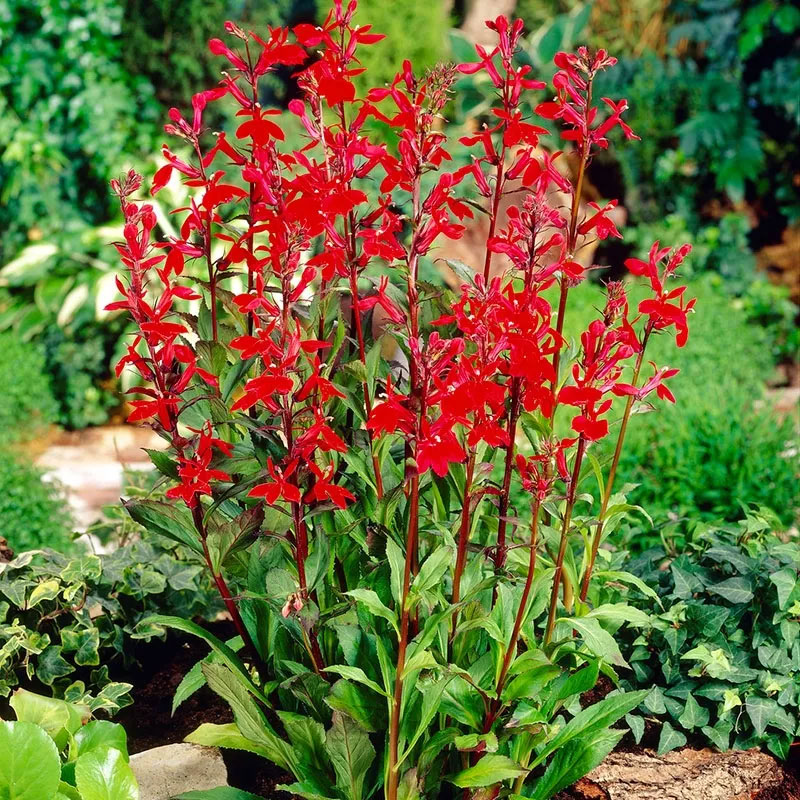
| Plant Size | Grows 3- to 4-feet tall with a spread of about 2 feet |
| Stem | Stems are angled, green in color, pubescent or glabrous, and rarely branched. |
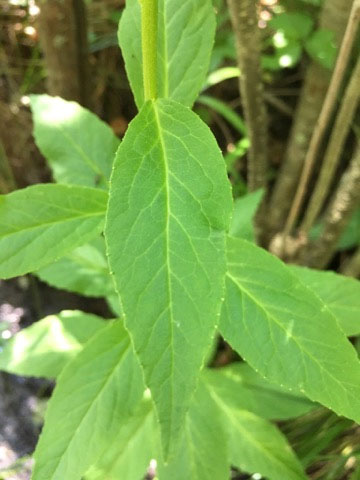
| Leaf | Lanceolate alternate leaves are up to 20 cm (8 in) long and 5 cm (2 in) wide. They are dark green above and light green below and mostly glabrous. Leaf blades gradually taper toward their bases with very narrow blade tissue continuing to the stem. |
| Flowering season | July to September |
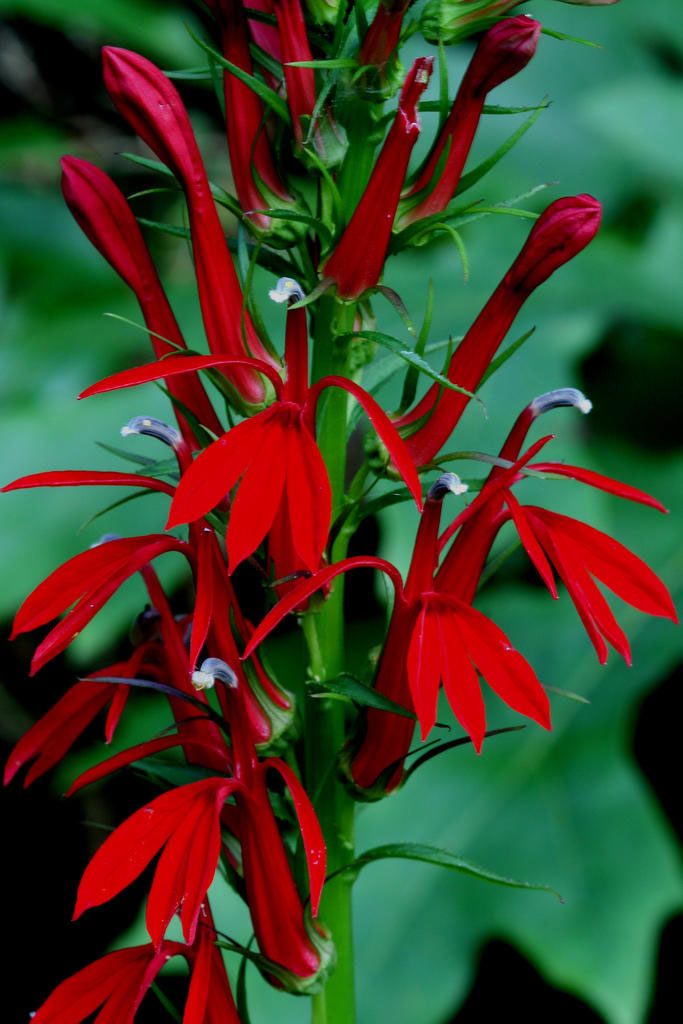
| Flower | Flowers are usually vibrant red, deeply five-lobed, up to 4 cm across; they are produced in an erect raceme up to 70 cm (28 in) tall during the summer to fall. Forms with white (f. alba) and pink (f. rosea) flowers are also known. |
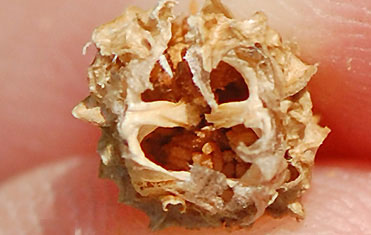
| Fruit Shape & Size | Fruit is a bell-shaped or oblong capsule that is about 4 inches long |
| Fruit Color | Initially green gradually turns tan to red-brown |
| Seed | Seeds are abundant, minute, brown, and elliptic to linear in shape. They are small, less than 1 mm. and numerous. |
| Propagation | By seeds, bud cuttings, or division |
| Plant Parts Used | Entire Plant |
| Culinary Uses |
|
| Other Facts |
|
Plant Description
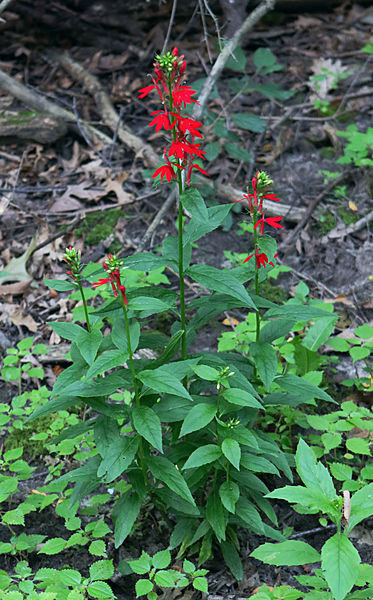
Cardinal Flower is an erect, tap rooted, clump-forming, herbaceous, aquatic, perennial plant that normally grows about grows 3- to 4-feet tall with a spread of about 2 feet. The plant is found growing in wet ditches, wet prairies, prairie swales, ravines, depressions, woodland edges, stream banks, roadsides, wet meadows, swamps, areas near lakes and ponds, openings in bottomland forests, sandy or gravelly seeps, edges of ponds, creeks or ditches and borders of marshes. The plant grows best in moderately moist to wet, organically rich soils. The plant adapts to loam, sandy loam, or gravelly soil. The soil should consist of some organic matter to retain moisture. The stems are angled, green in color, pubescent or glabrous, and rarely branched.
Leaves
Lanceolate alternate leaves are up to 20 cm (8 in) long and 5 cm (2 in) wide. They are dark green above and light green below and mostly glabrous. Leaf blades gradually taper toward their bases with very narrow blade tissue continuing to the stem. Leaf blades also gradually taper toward the tip (acuminate). Margins are somewhat sinuous and have short, irregularly coarse teeth (serrulate) that are angled toward the leaf tip. Leaf veins are slightly suppressed above and strongly raised below. The smooth upper leaf blade surface has a textured appearance due to upward flexing of the surface between veins. Leaves are positioned somewhat horizontally, but can droop toward the tips.
Flower
Inflorescences of cardinal flower occur in late summer as erect, terminal racemes, from one-fourth to one-third the height of the plant. Racemes have showy brilliant red flowers (rarely white or pink) that may be sparsely spaced or densely packed. Flowers, on short pedicels, are each subtended by a small linear bract. Flowers mature successively from the base of the raceme to the top, with flowering extending over a month or two, depending on site moisture.
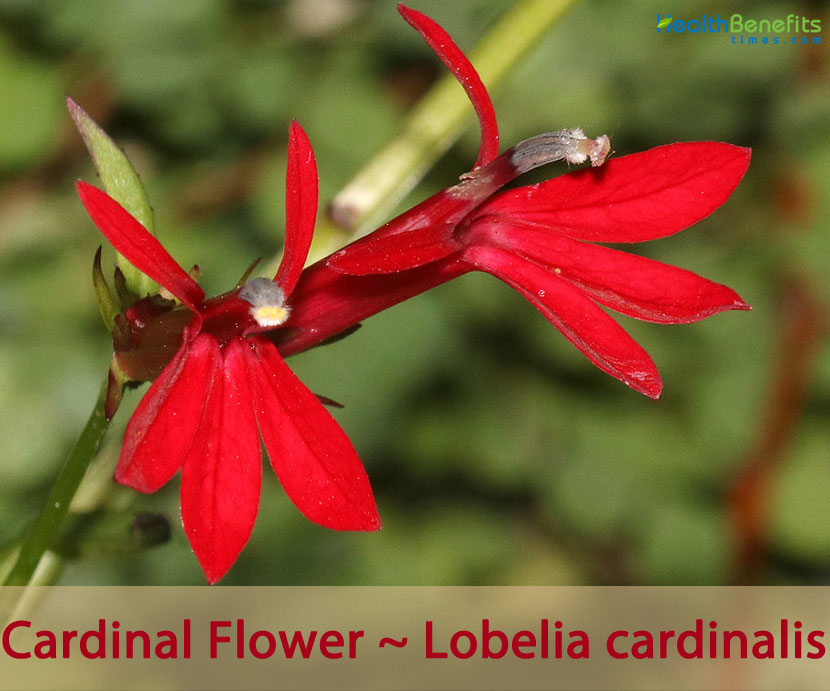
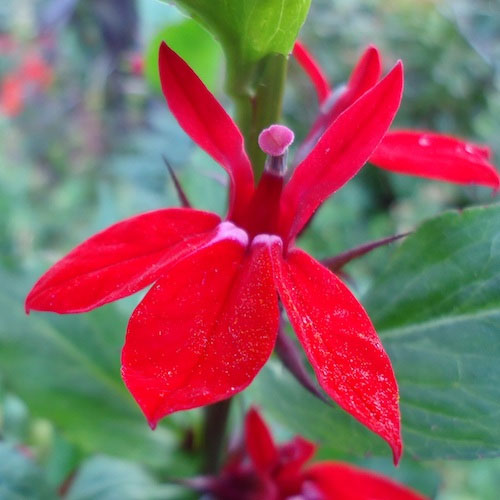
Flowers are positioned at about 45 degrees off the stem, are about 1½ inches long, with the front of the flower being about ¾ inch wide. Flower corolla consists of two slender upper lobes (flared and not connected to each other beyond the tube) and three lower broader lobes (connected at the bases beyond the tube and projecting out and slightly downward) together forming a fluted tube in the lower portion. The front surfaces of the corolla are a vibrant red (rarely white or pink) while the back surfaces, the tube and the filaments are often a lighter red. Two hazy dark lines can be seen at the juncture of the three lower corolla lobes. Five stamens have fused filaments that form a tube topped with greyish, down-turned and united anthers. This stamen tube tightly surrounds the pistil, which has a two-lobed stigma extending slightly from the stamen tube as the flower matures. A green, bell-like (campanulate) ribbed calyx has a raised rim and five projecting linear lobes. The corolla attaches immediately inside the calyx rim. The flowers are attractive to a number of butterflies and the Ruby-throated Hummingbird. Flowering normally takes place in between July to September.
 Immature-fruits-of-Cardinal-Flower
 Closer-view-of-flower-of-Cardinal-flower
 Cardinal-Flower-Plant
 Leaves-of-Cardinal-Flower
 Cardinal-Flower-plant-growing-wild
 Flowers-of-Cardinal-Flower
 Mature-fruits-of-Cardinal-Flower
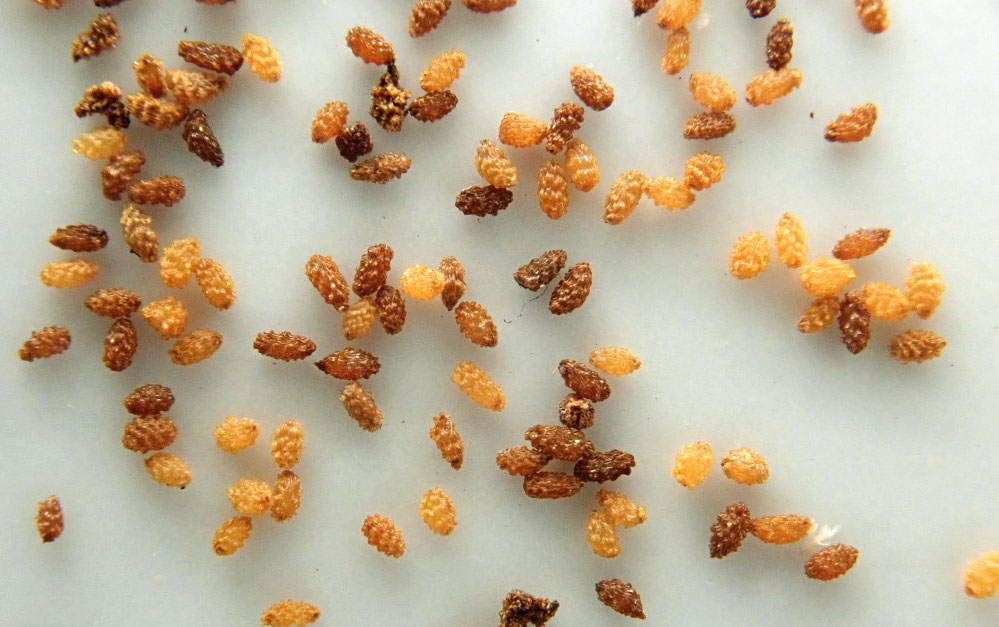 Seeds-of-Cardinal-Flower
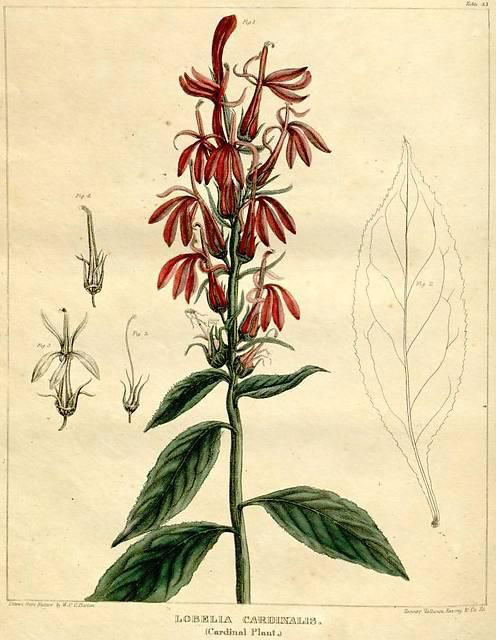 Plant-illustration-of-Cardinal-Flower
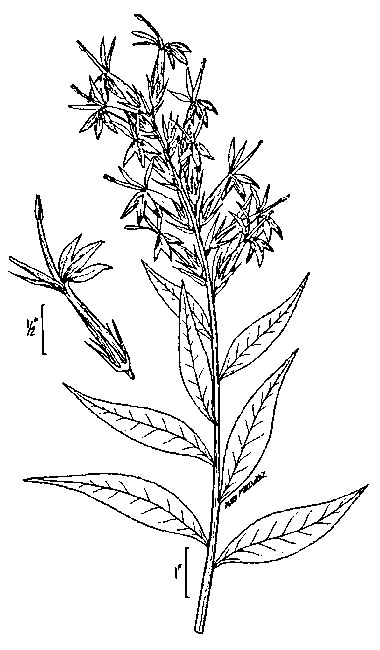 Sketch-of-Cardinal-Flower
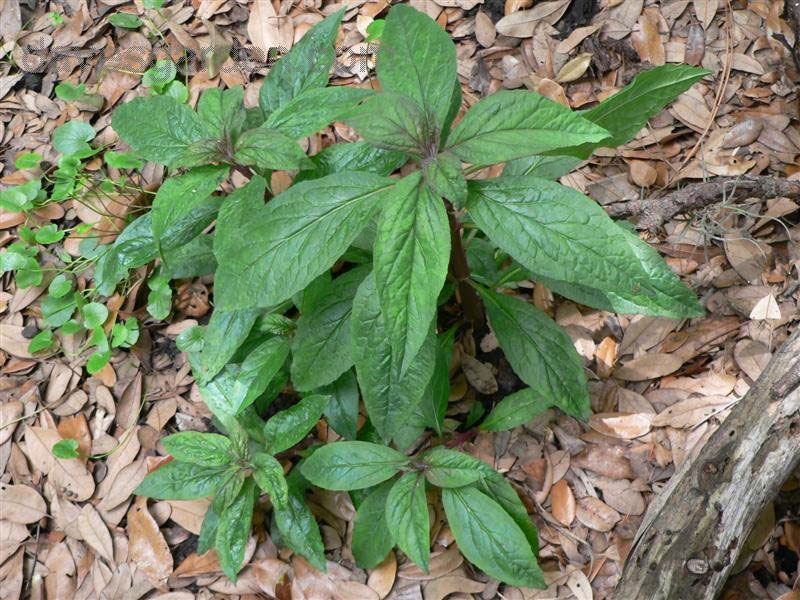 Sapling-of-Cardinal-Flower
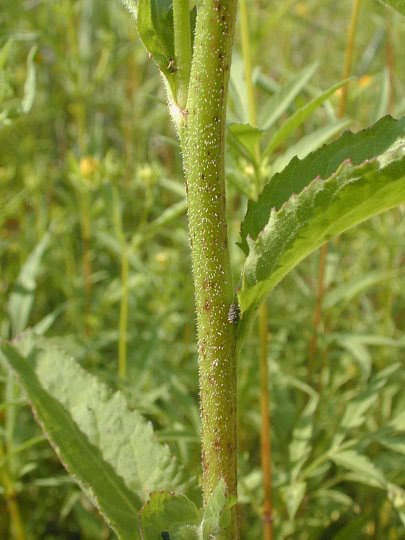 Stem-of-Cardinal-Flower
Fruit
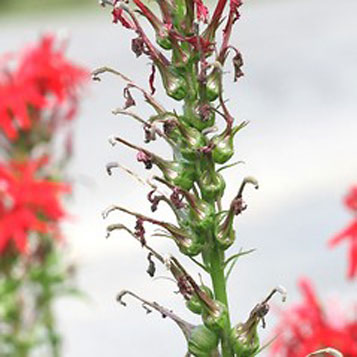
As a flower fades, the calyx enlarges. The calyx then serves as lower portion of the seed capsule (fruit) while the upper portion is a smooth, rounded or bell shaped and slightly pointed cap that is about 4 inches long. The fruiting capsule is divided into two sections (locales), within which a dense seed layer develops, such that each capsule contains hundreds of tiny, dust-like seeds. It is initially green gradually turns tan to red-brown and splits open in the fall. When seed capsules dry, only the top opens to release seeds. Seeds are abundant, minute, brown, and elliptic to linear in shape. Capsules also deteriorate over time and seeds are released for transport by wind and water. Plants can also be grown from seed, cuttings, or division of basal off-shoots.
History & Origins of Cardinal Flowers
Though the cardinal flower is native to North America, it’s been cultivated in Europe since the seventeenth century. French explorers came across the flower in Canada in the 1600s, and sent specimens back to France.
Its bright flowers quickly grew popular and European home gardens soon boasted these beautiful plants. A 1629 letter from English botanist John Parkinson describes receiving a packet of seeds from Paris that contained “the rich crimson cardinal flower…it growth near the river in Canada, where the French plantation in America is seated.”
Traditional uses and benefits of Cardinal Flower
- The root is analgesic, anthelmintic, antispasmodic and stomachic.
- Tea made from the roots has been used in the treatment of epilepsy, syphilis, typhoid, stomach aches, cramps, worms etc.
- A poultice of the roots has been applied to sores that are hard to heal.
- The leaves are analgesic and febrifuge.
- Tea made from the leaves is used in the treatment of croup, nosebleeds, colds, fevers, headaches etc.
- Poultice of the leaves has been applied to the head to relieve the pain of headaches.
- The plant is used to make a homeopathic remedy.
- In traditional medicine, the roots are used to treat syphilis and intestinal disease.
- The leaves are used to treat colds and bronchitis.
- The Zuni people use this plant as an ingredient of “schumaakwe cakes” and used it externally for rheumatism and swelling.
- The Iroquois used cardinal flower to treat fever sores, cramps, and upset stomachs.
- It was often added to other medicines to increase their strength.
- The Meskwaki used the plant as a ceremonial tobacco, throwing it to the winds to ward off storms.
- The Cherokee used an infusion of the root for worms, stomach troubles, and rheumatism.
- They also used an infusion of the leaf for colds and fevers.
- The plants were also used as a fever medicine and to treat consumption.
- Cherokee Indians used Lobelia for headache relief by crushing the plant and using a cloth to apply it to the pained area.
- An infusion with the root is used to treat digestive problems, typhoid, rheumatism, and worms.
- Infusions made from the leaves of the plant were used to treat colds and fevers.
- The Cherokee also used the plant to treat syphilis.
- The flower blossoms and roots were used as a treatment for cramps.
- The Iroquois would also use the whole plant as a treatment for overcoming grief.
- Roots, stems, leaves, and blossoms were mashed together and drank for cramping and the plant was used for diarrhea and other ailments.
- The Delaware tribe even attempted to fight off Typhoid with an infusion of cardinal flower roots.
- The Iroquois used the cardinal flower often in conjunction with other plants, to treat epilepsy, as a pain reliever, and to ease cramping.
- Healers also utilized the entire plant to help patients deal with grief.
- The Pawnee also used the flower to make aphrodisiacs and love potions believing, that possessing the blossoms made a man or woman irresistible.
- The mashed roots, stems, leaves, and blossoms were made into a decoction and drank for cramps.
- Teas from the leaves of the cardinal flower can be used to treat bronchial problems and colds.
- The liquid extract from the flowers has been known to upset the digestive system if consumed.
- The Pawnee used the roots and flowers of cardinal flower in the composition of a love charm.
Precautions
- The plant is potentially toxic, but the degree of toxicity is unknown.
- It contains the alkaloid lobeline which has a similar effect upon the nervous system as nicotine.
- The sap of the plant has been known to cause skin irritation.
- Overdoses will result in nausea, vomiting, diarrhea, salivation, exhaustion and weakness, dilation of pupils, convulsions, paralysis and coma.
- It is considered poisonous to humans and livestock and can cause death.
References:
https://www.itis.gov/servlet/SingleRpt/SingleRpt?search_topic=TSN&search_value=34505#null
https://pfaf.org/User/Plant.aspx?LatinName=Lobelia+cardinalis
https://www.missouribotanicalgarden.org/PlantFinder/PlantFinderDetails.aspx?taxonid=278870
https://gd.eppo.int/taxon/LOBCA
http://www.theplantlist.org/tpl1.1/record/kew-352312
https://en.wikipedia.org/wiki/Lobelia_cardinalis
https://www.fs.fed.us/wildflowers/plant-of-the-week/lobelia_cardinalis.shtml
https://edis.ifas.ufl.edu/publication/ag402
https://gobotany.nativeplanttrust.org/species/lobelia/cardinalis/
https://www.leelanaucd.org/uploads/1/2/7/5/127547435/cardinal_flower.pdf
https://www.illinoiswildflowers.info/wetland/plants/cardinal.htm