

Health Benefits
    Facebook Twitter Instagram
    Friday, December 5
    Facebook Twitter Pinterest
    Health Benefits
    • Home
    • Dental Health
    • Mental Health
    • Weight Loss
    • Health Wiki
    • Nutrition
    • Healthy Recipe
    • BMI Calculator
    Health Benefits
    Home»Herbs and Spices»Learn about Eastern Wahoo
    Herbs and Spices

    Learn about Eastern Wahoo

    By s mFebruary 27, 2020Updated:February 28, 2020No Comments6 Mins Read
    Facebook Twitter Pinterest LinkedIn Tumblr Email

    Wahoo in botany is a name of American Indian origin, most commonly applied to a large shrub, or small tree, 6–25 ft. tall native to North America. (The name Wahoo is also given to an Elm (Ulmus alata) and another variety, Euonymus americanus.)

    Eastern Wahoo has obtusely four-angled twigs; leaves, 2–5 in. long, oval in shape, with finely toothed margins and covered below with fine hairs. The purple flowers, appearing in May or June, are about ½ in. across are borne in groups of seven to fifteen on a short stalk. The fruit is a deeply four-lobed purple capsule bearing brown seeds covered with a scarlet aril. The plant grows in many sections of the United States, in woods and thickets and river bottoms. The bark of the root has a bitter and unpleasant taste.

    Plant description

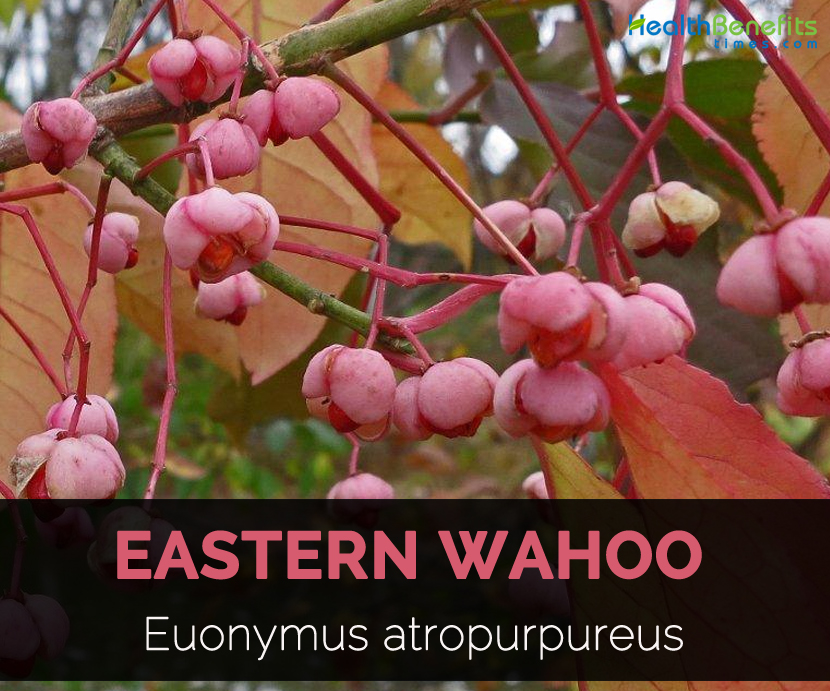
    Eastern Wahoo is a deciduous shrub or small tree which is grown for its attractive red berries and fall color. It occurs in the wild in open woods and thickets, near streams and on wooded slopes throughout the States. It typically appears as an upright, spreading, deciduous shrub with an irregular crown growing from 10 to 15 feet high. Leaves are dark green, elliptic to ovate which turns dull red to greenish red in fall. Flowers are small, purple which appears in leaf axils in late spring but are not showy. Flowers give way to scarlet red fruits about ½ inches which are found in autumn. Fruits are attractive to wildlife and are considered to be the best ornamental feature of the shrub. Fruits, leaves and bark of Eastern wahoo are used for various medicinal purposes.

    Flower

    Flowers form in branching clusters of 7 to 15 flowers that arises from leaf axils of lateral branchlets along one year old stems. Flowers are ¼ to 1/3 inch across, maroon to dark reddish-purple with four petals which are triangular and softly pointed at the tip. The center of the flower has a four lobed maroon to purple ovary with single short and yellow stamen on each lobe and stubby green style in the center. The flowers have four short sepals. Sepals and stalks are hairless.

    Facts About Eastern Wahoo

    Eastern wahoo Quick Facts
    Name: Eastern wahoo
    Scientific Name: Euonymus atropurpureus
    Origin Native to eastern North America
    Colors Reddish to pink
    Shapes Capsule, up to 17 mm diameter
    Name Eastern wahoo
    Scientific Name Euonymus atropurpureus
    Native Native to eastern North America
    Common/English Name American wahoo, Burningbush, Eastern wahoo, Hearts bursting with love, Bitter ash, Indian arrow, Euonymus, Indian arrow wood, Pegwood, Strawberry tree, Spindle tree, Whahow, Wauhoo
    Name in Other Languages German: Purpur-Spindelstrauch, Bitter-ash, Burningbush, Eastern burningbush, Eastern wahoo, Wahoo, Eastern burning-bush, Burning-bush euonymus;
    French: Fusain pourpre, Fusain de l’Est
    Plant Growth Habit Deciduous shrub
    Soil Well-drained
    Plant Size 8 m tall
    Bark Gray, smooth and lightly fissured
    Stem Round, smooth, 10 cm diameter
    Leaves Elliptical, 8.5–11.3 cm long, 3.2–5.5 cm broad
    Flowering Season June
    Flower Bisexual, 10–12 mm diameter
    Fruit shape & size Capsule, up to 17 mm diameter
    Fruit color Reddish to pink
    Seed Orange, ellipsoid, 7.0 to 11.0 by 4.0 to 5.5 mm
    Medicinal part Root bark

    Leaves and stems

    Leaves are opposite and simple about 2 to 6 inches long, 1 to 2½ inches wide which are generally elliptic, widest at or near the middle tapering or wedge shaped at the base. Tip is pointed or tapering to a sharp point sometimes abruptly so finely toothed around the edges and hairless on the upper surface and finely hairy on the lower. Stalks are ¼ to 2/3 inch long and hairless. Leaves turn yellow in the fall. Branchlets are weakly four sided, hairless, green and develops lines of pale and corky tissue along the angles which provides a striped appearance but eventually fade away. Branches are brown with age. Buds are cone shaped with sharply pointed tip. Bud scars are very light and nearly white. Older bark is thin, smooth to slightly rough and gray to gray brown. Trunks reach 1½ inches diameter at breast height. Usually stems are single and branches are few and erect to ascending, the shrub taking on an irregularly shaped crown.

    Fruit

    Fruit is a capsule about ½ inches across. Initially it is green turning pinkish and maturing to red. Typically four lobed but not all lobes may develop equally. When ripe, capsule splits open revealing 1 to 4 fleshy and bright red fruits called arils which contain two seeds.

    Distribution and habitat

    It is primarily found in the Midwestern United States. The range extends from southern Ontario south to northern Florida and Texas. It is found in low meadows, open slopes, open woodland, stream banks and prairies, in moist soils especially thickets, valleys and forest edges.

    Uses

    Valued in liver disorders especially those following or accompanied by fever. For constipation due to inactivity of liver it may be given with every confidence, especially as its action is mild and non-irritant. The influence is not restricted to the liver alone, the pancreas and spleen are also assisted by its properties. An effective agent for dropsy and dyspepsia, having cathartic effect. Euonymus is often used in combinations of other tonics, laxatives, etc., in pill form.

    Doses

    1 small teaspoonful to 2 cupfuls of boiling water, simmered 30 min., 2–3 cupfuls a day 1 hr. before meals.

    Medicinal uses

    • It has expectorant and diuretic effects but is used as purgative in case of constipation.
    • It is used for liver disorders and fever.
    • Prepare a decoction by adding an ounce to a pint of water and boil it slowly. Take a dose of small wineglassful two to three times a day for cold.
    • Stem and root bark is used as a cardiac, alterative, cholagogue, cathartic, expectorant, diuretic, laxative, hepatic, tonic and stimulant.
    • Use it in form of tea for treating malaria, constipation and liver congestion.
    • Apply the powdered bark to the scalp for eliminating dandruff.

    Side effects

    • Pregnant and breastfeeding women should not take it.
    • Bark of Eastern wahoo has caffeine so when taken in large amounts, it worsens diarrhea and IBs.
    • When taken in large doses, it causes intestinal and stomach disorders.

    References:

    https://www.itis.gov/servlet/SingleRpt/SingleRpt?search_topic=TSN&search_value=27948#null

    https://www.missouribotanicalgarden.org/PlantFinder/PlantFinderDetails.aspx?kempercode=k240

    https://botanical.com/botanical/mgmh/s/spindl82.html

    https://en.wikipedia.org/wiki/Euonymus_atropurpureus

    https://pfaf.org/user/Plant.aspx?LatinName=Euonymus+atropurpureus

    https://www.planetayurveda.com/wahoo-bark/

    https://www.minnesotawildflowers.info/shrub/eastern-wahoo

    http://medicinalherbinfo.org/000Herbs2016/1herbs/wahoo/

    82%
    82%
    Awesome

    Comments

    comments

    E Herbs and Spices
    Share. Facebook Twitter Pinterest LinkedIn Tumblr Email
    Previous ArticleLiquid Vitamins vs. Pills: Which Is Better?
    Next Article Facts about False Barley

    Related Posts

    Uses of Monkey Pitcher plant

    April 16, 2024

    Traditional uses and benefits of Wild Marigold

    March 21, 2024

    Traditional uses and benefits of Drooping fig

    March 12, 2024

    Comments are closed.


    Eastern wahoo Scientific Classification

    Scientific Name: Euonymus atropurpureus

    Rank Scientific Name & (Common Name)
    Kingdom Plantae (Plants)
    Subkingdom Viridiplantae  (Green plants)
    Infrakingdom Streptophyta (Land plants)
    Superdivision Embryophyta
    Division Tracheophyta  (Vascular plants, tracheophytes)
    Class Magnoliopsida
    Subclass Rosidae
    Order Celastrales
    Family Celastraceae  (Bittersweet)
    Genus Euonymus L. (Burningbush, spindletree)
    Species Euonymus atropurpureus Jacq. (Eastern burningbush, burningbush, wahoo, eastern wahoo)
    Synonyms
    • Euonymus atropurpurea var. atropurpurea Jacq.
    • Euonymus atropurpureus var. atropurpureus Jacq.
    • Euonymus atropurpureus var. cheatumis Lundell
    • Euonymus atropurpureus var. grandifolius Raf.
    • Euonymus atropurpureus var. latifolius Raf.
    • Euonymus atropurpureus var. oblongifolius Raf.
    • Euonymus caroliniensis Marshall
    • Euonymus latifolius Marshall
    • Euonymus macrocarpus Hort.
    • Euonymus tristis Salisb.
    Categories
    • Beverages (78)
    • Dairy (28)
    • Dental Health (15)
    • Equipment (5)
    • Essential OIls (196)
    • Facts (2,939)
    • Foods (255)
    • Fruits (516)
    • Giveaway (1)
    • Grains and Cereals (36)
    • Health & Beauty (763)
    • Herbs and Spices (1,249)
    • Medicines (9)
    • Mental Health (19)
    • Nutritional value (27)
    • Nuts and seeds (73)
    • Oils (81)
    • Pets (4)
    • Poultry & Seafoods (67)
    • Pulses and Beans (16)
    • Reviews (25)
    • supplement (2)
    • Vegetables (304)
    • Weight Loss (22)

    What is Lupin Bean Flour?

    Science Backed Health Benefits of Durian (Durio zibethinus)

    Science Backed Health Benefits of Feijoa (Pineapple Guava) (Acca sellowiana)

    Science Backed Health Benefits of Gac Fruit (Momordica cochinchinensis)

    Science Backed Health Benefits of Amaranth Leaves (Amaranthus spp)

    Science Backed Health Benefits of Arrowhead (Sagittaria sagittifolia)

    ABOUT
    Home
    About us
    Contact us
    Privacy Policy
    Terms & conditions
    Disclaimer
    Direct Communication
    e-mail: [email protected]
    Gmail: [email protected]
    Whatsapp: +977-9841146511
    Viber: +977-9841146511
    Useful
    Health Wiki
    Nutrition
    Facebook Twitter Pinterest
    © 2025 www.healthbenefitstimes.com All rights reserved.

    Type above and press Enter to search. Press Esc to cancel.

    ×

    Log In

    Forgot Password?

    Not registered yet? Create an Account