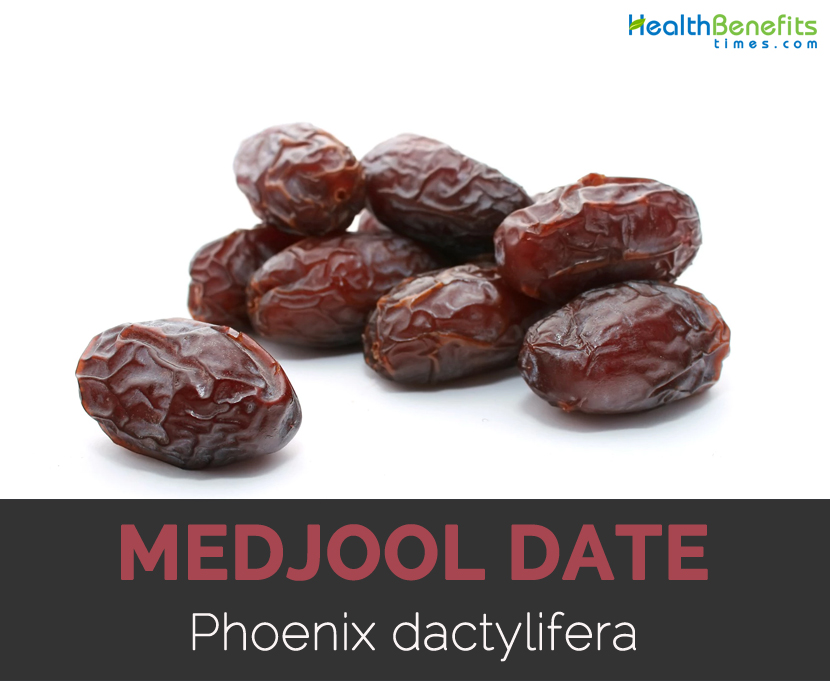
Date palm scientifically known as Phoenix dactylifera, is a monocot plant belonging to family Arecaceae which is cultivated in dry tropical regions worldwide for its sweet edible fruit. The native range is crucial to ascertain as it is spread through cultivation for thousands of years but is believed to have originated in region around Persian gulf- the Arabian peninsula and Northwest India. Since ancient times, dates have been cultivated from Mesopotamia and Babylonia to prehistoric Egypt as early as 4000 BCE. Fruits are used by Ancient Egyptians to make date wine and consume them at harvest.
Dates are medium sized growing singly or forming in a clump having several stems from single root system. It does not grow woody tissue but support them having stout fibrous and overlapping stems and measures 15 to 25 meters tall (50 to 80 feet). Leaves measures 3 to 5 meters long having spines on petiole and pinnately compound with 150 leaflets. Leaflets measures 2 cm wide and 30 cm long. They are dioecious and wind pollinated but often hand pollinated in commercial production for better fruits and is propagated by cuttings to minimize number of male trees.
Fruits are oval to cylindrical measuring 3-7 cm long and 2-3 cm diameter having single seed measuring 2-2.5 cm long and 6-8 mm thick. Dates have three main cultivar groups such as semi-dry, soft and dry having numerous varieties in each group including hybrids with other Phoenix species. Dates with high content of sugar are consumed fresh and used in preparing desserts and foods with substantial regional dishes in India and Middle East and used in holiday fruitcakes in Europe and U.S. Besides its edible fruits, seeds are grounded into edible flour used for making bread at the times of scarcity. Flowers could also be consumed and used in salads or dried & ground as condiment. Date palm could be grown from the seed but 50 percent of seedlings are female and bears fruit and dates from seedlings plants are of poorer quality and smaller.
They are mentioned in the Koran and the Bible and essential in Indian mythology. In tropical areas, they are a vital crop with 7.5 billion metric tons as 2009 global production. Egypt, Saudi Arabia and Iran are the top producers. The commercial plantations use cuttings of heavily cropping cultivars. In comparison to seedling plants, plants cultivated from cuttings bear fruit 2 to 3 years earlier. Naturally dates are wind pollinated but manual occurs in modern commercial orchards and traditional oasis horticulture. A male could pollinate upto 100 females with assistance.
Mature trees produce from 68 to 176 kilograms of dates per harvest season though they do not ripen at the same time so it requires several harvests. For getting fruit of marketable quality, bunches of dates must be thinned and covered or bagged before ripening so remaining fruits grow larger and are protected from pests and weather.
Description
Medjool date is a solitary tree measuring 30 meters with suckers producing offsets or roots present at base. Leaves are glabrous measuring 1 to 5.1 meters long with many leaflets about 20-40 x 2-2.5 cm. Lower leaflets are 4-ranked and transformed into spines and upper ones are 2-ranked measuring 10 to 20 cm long with yellowish apex. Inflorescence is covered by hard and boat like bract. Female inflorescence measures 90 to 120 cm and main stalk is flat about 45 to 75 cm long and glabrous with numerous spikelets. Flowers are distant, green and rounded. Sepals measures 4 x 2 mm and petals are two times larger than sepals and are rounded. Flowers are white, sessile and sweet scented with much larger than female flower. Stamens are 4 mm long with short filaments and erect anthers. Petals are valcate, 3-lobed measuring 7-8 mm long. Fruit is edible, fleshy, cylindric, yellowish-brown to reddish brown and about 2.5-5.0 x 1-1.5 cm broad. Seeds are stony, longitudinally grooved from one side and acute at apex.
Sap
Medjool date is tapped for palm wine in large parts of Northern India. In Pakistan and other countries, it is tapped for palm syrup and jaggery production. In Africa, wild date pals are tapped for palm wine. Palm tapping process involves laceration of unopened flower stalk and then fastened a bottle gourd, plastic or clay vessel on to it. The sap collects in vessel and is harvested in early morning hours. If lime juices (few drops) are added to palm sap then fermentation can be stopped and sap could be boiled to form palm sugar, palm syrup, jaggery and various other edible products derived from syrup. In Pakistan, India, Ghana, North Africa and Côte d’Ivoire, dates are tapped for sweet sap which is transformed into palm sugar, alcoholic beverages or molasses. In North Africa, sap extracted from tapping palm trees is called lāgbī. If left for adequate time period, lāgbī becomes an alcoholic drink. Tapping requires a special skill so that it does not die.
Leaves
In Christian religion, date palm leaves are used for Palm Sunday. They are commonly used for making huts in North Africa. Leaves (matured ones) are made into screens, mats, fans and baskets. The dried leaf petioles are a source of cellulose pulp used for brooms, walking sticks, fuel and fishing floats. Leaf sheaths are valued highly for their scent and fiber from them are used for coarse cloth, rope and large hats. Leaves are used in Jewish holiday of Sukkot as lulav.
Young leaves are cooked and consumed as vegetable and is the terminal heart or bud and its removal damages the palm. Seeds which are finely ground are combined with flour for making bread at the times of scarcity. The flowers are also consumable. Flower buds are used in salad or ground with dried fish for making a condiment for bread.
History of dates
Medjool date is one of the varieties of dates. The larger size, decadently sweet flavor and chewy texture have made Medjool prized for millenniums. It is regarded as an oldest cultivated fruit having an evidence of its consumption in Middle East by ancient cultures dating back to around 6000 B.C. Fruit was highly coveted historically due to its difficult and labor intensive cultivation. Enjoyed exclusively by royalty & reserved for lavish celebrations hence inspire titles “The Diamond of Fruits” and “The King of Fruits”. In 1927, Medjool palms first came to United States when an American horticulturist, Walter Swingle rescued nine offshoots from Moroccan crops threatened by disease. Nine offshoots were brought to California and then planted in Coachella Valley where 75% of dates are grown in United States. In the Coachella Valley, all Caramel Naturel dates grow. In modern times, Medjool dates are widely accessible by integrity of successful California farming and advances in technology which makes more efficient cultivation. Its presence in U.S. and California over the last century helped fruit to adapt itself diversely into American culinary culture. The awareness of nutritional content of Medjool has widespread demand. Medjool continues to become as popular; it will always have a quality and tradition of being exotic, special and utterly delicious.
Health Benefits of Medjool dates
Some sort of health benefits which Medjool dates provides:
Lower cholesterol
Medjool dates are a smartest choice to maintain healthy levels of cholesterol. Its consumption helps to increase both insoluble and soluble fiber intake which could lower the cholesterol naturally especially bad cholesterol. LDL cholesterol contributes to heart disease, heart attacks and strokes. Presence of too much cholesterol in the blood forms sticky deposits known as plaque along artery walls. Eventually, plaque blocks or narrows the flow of blood to the heart, brain and other organs.
Blood cells which get caught on plaque forming clots could break loose or block the blood flow completely through artery causing stroke or heart attack. It is recommended to include high fiber foods such as dates for people suffering from high cholesterol.
Constipation relief
Dates are one of the top foods for providing relief from constipation. Presence of high fiber content makes it a superb choice to keep oneself regular. But if one have occasional constipation or have bleeding or severe pain then consult the doctor because the symptoms could be a symptom of digestive disorder. In case of no pain or bleeding then it is the sign of constipation that diet needs more fiber content. The requirement for an average adult is 25-30 grams of fiber per day for preventing constipation.
With high soluble fiber, dates keeps the movements of bowel regular with the addition of bulk to stool and also assist to move it faster from intestines. Use Medjool dates as a natural remedy for providing relief from constipation.
Energizes body
Medjool dates could be used as a post workout or pre-workout snack. Dates have high content of sugar than other fruits. Dates have high content of natural sugar such as glucose, fructose and sucrose. These sugars are processed and utilized easily by the body for energy. Consume few Medjool dates or add it to snack for getting energy. It is also used to combat tiredness.
Manage triglyceride levels
Medjool dates provide healthy boost to heart. Study have shown that Medjool dates have high content of antioxidant properties. Results showed that the consumption of 100 grams of Medjool dates daily for four weeks lowered the level of blood triglycerides by 8 percent.
Triglycerides are the type of lipid fat in the blood. The high triglyceride levels helps to promote the chances of heart problems so it helps to maintain the triglycerides at normal level.
Stronger bones
Medjool dates contain significant amounts of basic minerals that help to strengthen bones and counteract painful or debilitating bone disease such as osteoporosis. Add dates to the diet for people with osteoporosis. Dates have high content of calcium and with phosphorus it closely works for building strong bones or teeth. About 85% of the phosphorus of the body is in teeth and bones. Phosphorus is essential for maintenance, growth and repair of tissues and cells and for production of DNA, RNA and genetic building blocks. It is essential for balancing and also use of other minerals or vitamins such as zinc, magnesium, iodine and Vitamin D.
Calcium is the must mineral for the body to develop and maintain strong bones and teeth. Calcium helps to keep nerves, heart, other body systems and muscles work properly and also help to prevent osteoporosis. As the people ages, the bones become weak and should maintain diet rich in both phosphorus and calcium to combat bone degradation. The regular consumption of Medjool dates helps to uptake an intake of phosphorus and calcium.
Increment in metabolism
Medjool dates contain B vitamins such as pantothenic acid, niacin and folic acid that helps to regulate metabolism along with 300 different metabolic processes which are carried out within the body every single day. Moreover, it contains copper in significant amount that promotes absorption and generates energy within the body.
Neutralize free radicals
Medjool dates possess manganese that acts as a basic co-factor of superoxide dismutase which is an antioxidant that effectively neutralizes free radicals and also prevent the damage of cells.
Provides radiant skin
Medjool dates have good amounts of panthothenic acid and niacin. These nutrients and vitamins help the one to provide healthy and radiant skin. So one should consume 2-3 dates every day.
Combat anemia
Being a rich source of minerals such as iron, it helps to maintain hemoglobin count and prevents the chances of anemia. Add 3-4 dates to the daily diet and prevent the chances of iron deficiency.
Brain functions
Dates help to protect against inflammation and oxidative stress in brain. The daily consumption of dates lowers the chances of neurodegenerative diseases and provides better cognitive performances in older individuals. It also slows down the chances of Alzheimer’s. Study shows that dates help to prevent inflammation in brain.
Treat hemorrhoids
During pregnancy, hemorrhoids are common complication and are caused by insufficient intake of fiber. Dates are an excellent source of fiber as we discussed already. It prevents the chances of hemorrhoids at the time of pregnancy.
Storage
Store it open or closed for upto 6 months under refrigeration. It could also be frozen.
Traditional uses
Dates are used for treating fevers and respiratory diseases.
Gum is used to treat diarrhea.
Precautions
Consumption of Medjool date with pit causes choking.
Monitor blood sugar due to high natural sugar content in Medjool dates.
It may cause allergies such as tongue swelling, runny nose, facial redness or itchy eyes. Discontinue its consumption and seek for medical attention.
Medjool date is not good for those trying to lose weight or diabetes patients.