


Knee cartilage is a specialized connective tissue that acts as a protective cushion and shock absorber within the joint. The knee primarily relies on articular cartilage, a smooth, highly lubricated layer of hyaline tissue approximately two to four millimeters thick that covers the ends of the femur and tibia. Its primary function is to minimize friction and evenly distribute mechanical loads during movement 1. Because articular cartilage completely lacks blood vessels, nerves, and lymphatic systems, it has a strictly limited capacity for natural healing or regeneration if damaged 1. Consequently, progressive wear, injury, or focal lesions in this tissue often lead to permanent degradation, which is the primary structural cause of knee osteoarthritis 2. Maintaining the structural integrity of this resilient but vulnerable tissue is essential for long-term, pain-free joint mobility.
Natural Remedies to Regenerate Knee Cartilage Naturally
1. Weight Management
How It May Help
Carrying excess body weight significantly increases physical stress on knee joints and promotes systemic inflammation through chemicals released by fat tissue. Losing weight reduces this mechanical burden and lowers inflammation. This creates a favorable joint environment, slowing structural breakdown and allowing cartilage to preserve its matrix 3.
What Research Says
Clinical studies demonstrate that substantial weight loss directly slows the degradation of knee cartilage over time. Research confirms that reducing body mass significantly lowers joint compression forces and decreases biological markers of tissue breakdown, ultimately preserving existing cartilage and reducing the overall progression of joint damage 4.
How to Use It Safely
To manage weight safely, focus on a balanced, nutrient-rich diet to create a steady caloric deficit. Combine dietary changes with low-impact physical activities, such as swimming, stationary cycling, or water aerobics, which burn calories without placing additional destructive stress on your knee joints.
Potential Precautions or Side Effects
Avoid high-impact exercises like running or jumping, which can accelerate cartilage damage. Additionally, skip extreme calorie-restricted diets, as severe nutrient deficiencies will further weaken your bones and joint tissues.
2. Low-Impact Exercise
How It May Help
Because knee cartilage lacks a direct blood supply, it relies entirely on physical movement to absorb essential nutrients. Low-impact exercise acts as a mechanical pump, actively circulating nutrient-rich synovial fluid into the tissue to sustain cellular repair and prevent tissue starvation 1.
What Research Says
Clinical reviews confirm that consistent, low-impact mechanical loading improves cartilage quality. Studies conclude that moderate exercise stimulates chondrocytes—the primary cells in cartilage—to produce a stronger structural matrix, which actively prevents further tissue thinning and improves overall joint resiliency 5.
How to Use It Safely
Perform activities like stationary cycling, elliptical training, or water aerobics for 30 to 45 minutes most days of the week. Always complete a gentle warm-up first, and maintain a smooth, controlled motion to safely condition the joint without overloading it.
Potential Precautions or Side Effects
Stop immediately if you experience sharp pain, locking, or new swelling. Forcing a compromised knee through acute pain can worsen micro-tears and accelerate existing cartilage degradation.
3. Glucosamine and Chondroitin Sulfate Supplements
How it may help
Glucosamine and chondroitin are natural structural components of joint cartilage 6. These supplements are theoretically thought to support joint health by reducing inflammation, preventing further cartilage breakdown, and providing the essential building blocks needed to maintain tissue elasticity 7.
What research says
Despite their popularity, rigorous studies show these supplements do not regenerate lost cartilage or cure osteoarthritis 8. While some patients report mild pain relief, extensive clinical trials conclude they offer no clinically significant benefit over a placebo for long-term joint repair 9.
How to use it safely
If you choose to try them, purchase high-quality supplements to ensure purity. Take them daily as directed by your healthcare provider for a trial period of two to three months, and discontinue use if you do not notice any meaningful improvement in your knee pain.
Potential precautions or side effects
Though generally safe, these supplements can occasionally cause mild stomach upset 10. Always consult your doctor first, especially if you take blood-thinning medications or have specific health conditions.
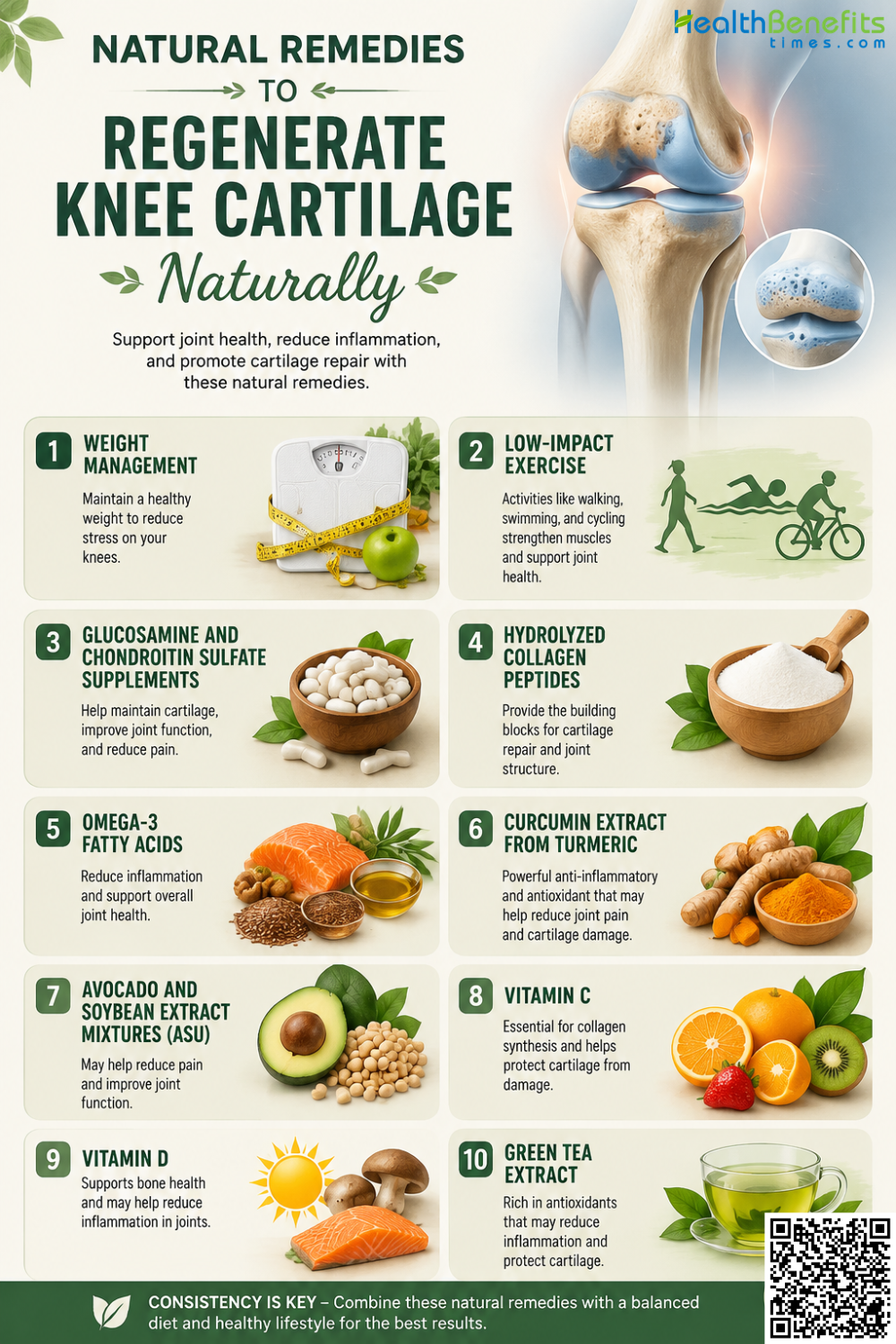
4. Hydrolyzed Collagen Peptides
How it may help
Hydrolyzed collagen peptides provide specific amino acids that act as the building blocks for joint tissue. They may help stimulate cartilage cells to produce new collagen, potentially improving joint elasticity and reducing the localized inflammation associated with cartilage breakdown 11.
What research says
Clinical studies suggest that daily hydrolyzed collagen supplementation can modestly reduce joint pain and improve mobility in osteoarthritis patients 12. However, current evidence does not prove it fully regenerates lost knee cartilage, making it a supportive measure rather than a structural cure.
How to use it safely
To use collagen safely, select high-quality powders from reputable manufacturers to avoid contaminants. You can mix the standard daily dose of five to ten grams into beverages or food. Consistent use for at least three months is typically required to notice potential benefits.
Potential precautions or side effects
Collagen peptides are generally safe but may occasionally cause mild digestive discomfort, such as heartburn or a feeling of heaviness 13. Always check labels if you have food allergies.
5. Omega-3 Fatty Acids
How it may help
Omega-3 fatty acids interrupt the biological pathways that trigger joint inflammation and cartilage degradation 14. By suppressing destructive enzymes in the knee, these essential fats help preserve the existing cartilage matrix and create a favorable internal environment for tissue maintenance 15.
What research says
Clinical evidence shows that regular omega-3 consumption significantly reduces joint stiffness and pain associated with osteoarthritis 16. However, studies conclude that while these fats successfully slow joint degradation and prevent further tissue loss, they cannot actively regrow knee cartilage that has already been destroyed 17.
How to use it safely
To increase your intake safely, eat fatty fish weekly or take a daily fish oil supplement. If using supplements, choose products containing both EPA and DHA and take them with meals to maximize absorption and minimize mild digestive upset 18.
Potential precautions or side effects
High doses of omega-3s may increase your risk of bleeding 19. You must consult your doctor before starting them if you take blood-thinning medications or anticipate undergoing surgery.
6. Curcumin Extract from Turmeric
How it may help
Curcumin, the active compound in turmeric, acts as a powerful natural anti-inflammatory agent. It works by blocking specific enzymes and chemical pathways that actively break down joint tissue 20. By neutralizing this internal stress, curcumin helps preserve the existing knee matrix and prevents further cartilage destruction 21.
What research says
Clinical trials confirm that curcumin effectively reduces joint pain and swelling, often matching the relief provided by standard non-steroidal anti-inflammatory drugs 22. Despite providing significant symptomatic relief, research consistently concludes that curcumin does not structurally regrow or repair knee cartilage that has already deteriorated 23.
How to use it safely
To maximize effectiveness, you should select curcumin supplements formulated with black pepper extract, which dramatically increases its absorption into the bloodstream 24. Take a standard dose of 500 to 1,000 milligrams daily alongside a meal containing fats to safely improve how well your body utilizes it.
Potential precautions or side effects
Curcumin is highly tolerable but may occasionally cause mild stomach upset. You must consult your doctor before using it if you take blood-thinning medications or have existing gallbladder issues 25.
7. Avocado and Soybean Extract Mixtures (ASU)
How it may help
Avocado and soybean unsaponifiables (ASU) are natural plant extracts that block inflammatory chemicals in the joints 26. By suppressing these destructive pathways, ASU helps prevent further cartilage breakdown and stimulates the body to produce collagen, a crucial structural protein needed to maintain existing joint tissue 27.
What research says
Clinical studies confirm that ASU significantly reduces joint pain and stiffness, helping osteoarthritis patients decrease their reliance on pain medications 28. However, research concludes that while ASU effectively slows the narrowing of the joint space and protects remaining tissue, it cannot regrow or regenerate lost knee cartilage 29.
How to use it safely
You should take a standardized ASU supplement at a dose of 300 milligrams once daily 26. Take the capsule with a meal to maximize absorption. You must use it consistently for at least two to three months to notice meaningful improvements in knee mobility and pain.
Potential precautions or side effects
ASU is generally safe, though it may occasionally cause mild stomach upset 29. You should consult your doctor first if you have severe soy or avocado allergies.
8. Vitamin C
How it may help
Vitamin C is biologically essential for synthesizing collagen, the primary structural protein that forms the framework of joint cartilage. By acting as a powerful antioxidant, it neutralizes harmful free radicals, helping to protect existing knee tissue from further degradation and supporting joint maintenance 30.
What research says
Clinical research indicates that adequate vitamin C intake significantly reduces the risk of joint space narrowing and osteoarthritis progression 31. However, studies conclude that while this nutrient successfully protects remaining tissue, it cannot actively regenerate or rebuild knee cartilage that has already deteriorated 32.
How to use it safely
To safely increase your intake, you should consume a daily diet rich in citrus fruits, strawberries, and bell peppers. If you opt for supplements, take 75 to 90 milligrams daily, avoiding the safe upper limit of 2,000 milligrams per day 33.
Potential precautions or side effects
Vitamin C is safe, but excessive intake may cause diarrhea, nausea, or stomach cramps. You should avoid extreme doses to minimize the potential risk of developing kidney stones 34.
9. Vitamin D
How it may help
Vitamin D is crucial for absorbing calcium and maintaining the bone underneath joint cartilage. By strengthening this underlying bone structure and reducing localized inflammation, it provides a stable foundation that protects existing knee cartilage from excess mechanical stress and breakdown 35.
What research says
Clinical studies indicate that Vitamin D deficiency accelerates joint space narrowing and osteoarthritis progression 36. However, extensive trials conclude that while correcting this deficiency modestly reduces knee pain, vitamin supplementation cannot actively regenerate or rebuild cartilage that has already deteriorated 37.
How to use it safely
To maintain optimal levels safely, you should get routine sun exposure and consume fortified foods. If supplementing, take a daily dose of 600 to 800 International Units of Vitamin D3 38. Ask your doctor to check your blood levels to determine your exact needs.
Potential precautions or side effects
Vitamin D is safe at recommended doses, but extreme over-supplementation can cause dangerously high blood calcium levels, leading to nausea, muscle weakness, and kidney stones 39.
10. Green Tea Extract
How it may help
Green tea contains epigallocatechin-3-gallate (EGCG), a natural antioxidant that acts as a powerful anti-inflammatory agent. EGCG protects existing knee tissue by directly blocking specific enzymes responsible for breaking down the structural proteins in joint cartilage 40.
What research says
Clinical evidence shows that green tea polyphenols effectively reduce joint pain, decrease swelling, and slow the overall progression of osteoarthritis 41. However, while the extract successfully preserves remaining joint structure, researchers conclude it cannot actively regrow or regenerate lost knee cartilage 42.
How to use it safely
To use this safely, drink two to four cups of brewed green tea daily. If choosing concentrated extract supplements, limit your daily intake to 250 to 500 milligrams. Always take capsules with food to maximize bodily absorption and minimize the risk of mild stomach upset.
Potential precautions or side effects
High-dose green tea extract can cause severe liver toxicity 43. Consult your doctor before starting supplements, especially if you have liver conditions or take prescription medications.
Foods to Avoid When You suffer from Knee Cartilage problems
1. Added Sugars and Sweets
Excessive sugar increases blood glucose, directly triggering cellular damage and stimulating the production of inflammatory chemicals that break down knee cartilage 44.
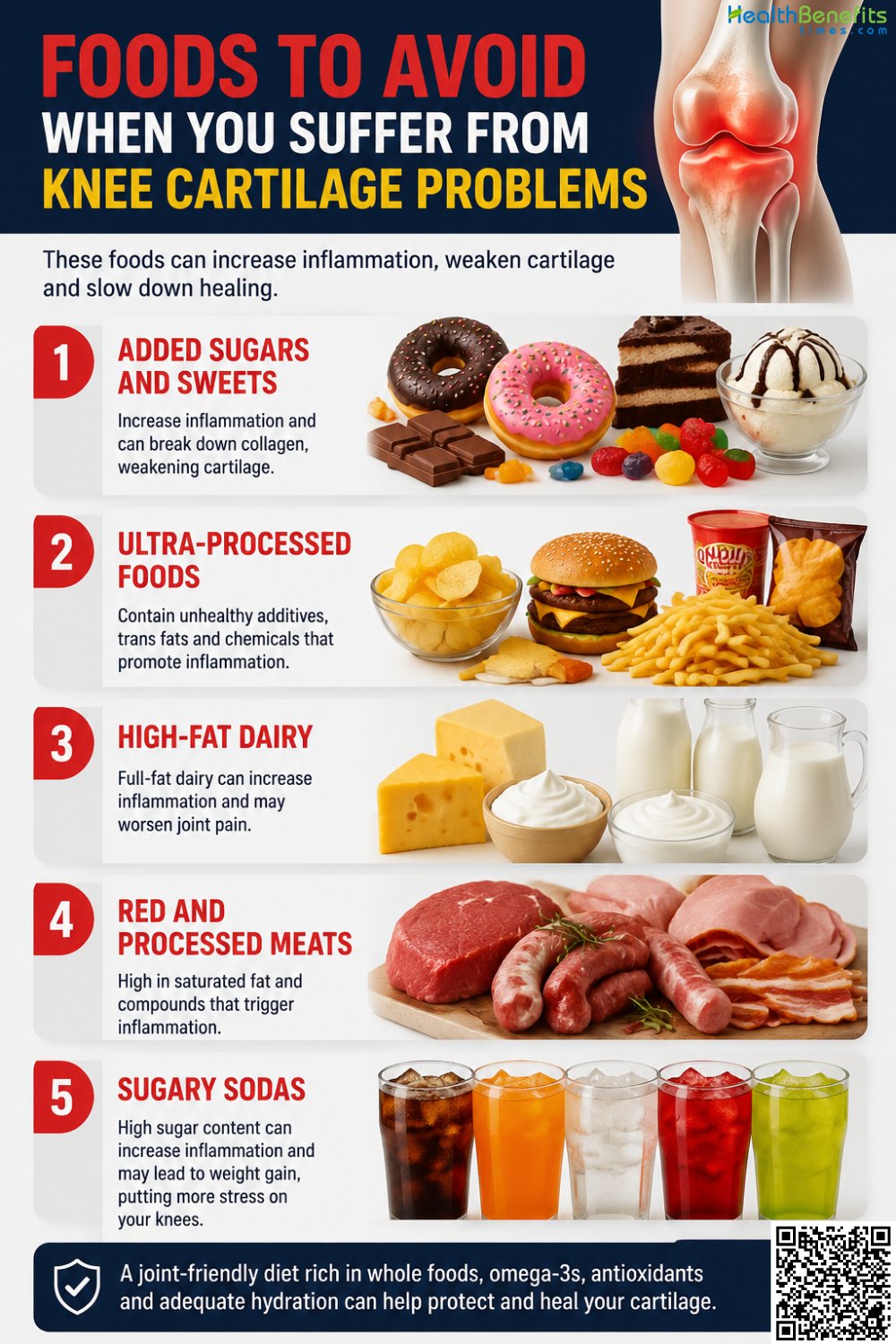
2. Ultra-Processed Foods
Processed items are primary sources of dietary advanced glycation end products (AGEs) 45. These compounds cause systemic inflammation that accelerates joint tissue deterioration 46.
3. High-Fat Dairy
Consuming a diet with a high percentage of energy from saturated fats is significantly linked to the structural progression of knee osteoarthritis 47.
4. Red and Processed Meats
Meats cooked at high temperatures contain elevated levels of AGEs 45. These accumulate in cartilage over time, initiating a destructive inflammatory cascade within the joints 46.
5. Sugary Sodas
Clinical surveys indicate that consuming sodas sweetened with sugar frequently worsens joint pain and arthritis symptoms by creating a pro-inflammatory environment within the body 48.