| Serrano pepper Quick Facts |
| Name: |
Serrano pepper |
| Scientific Name: |
Capsicum anuum |
| Origin |
Mexican states of Puebla and Hidalgo |
| Colors |
Dark green or red (Fruit) |
| Shapes |
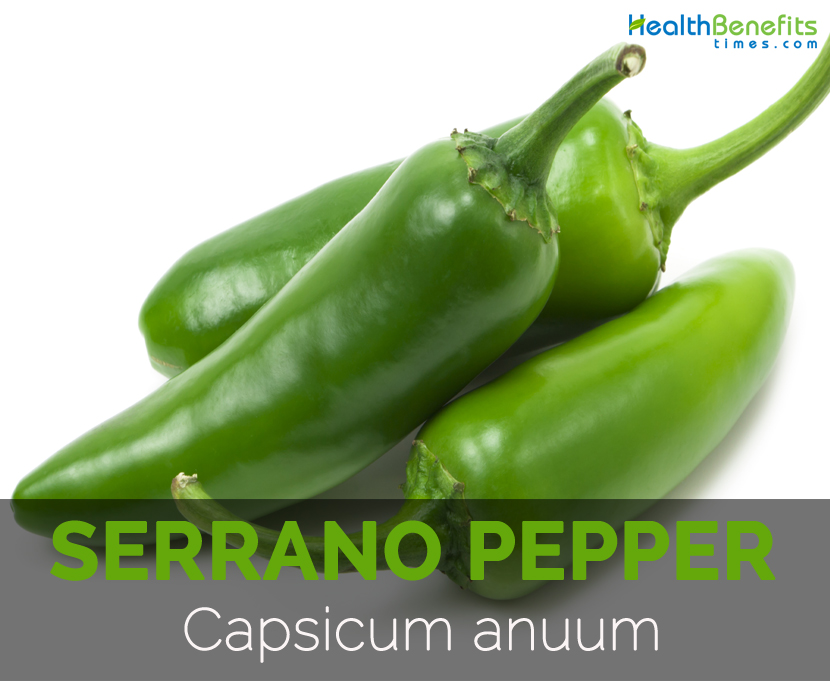
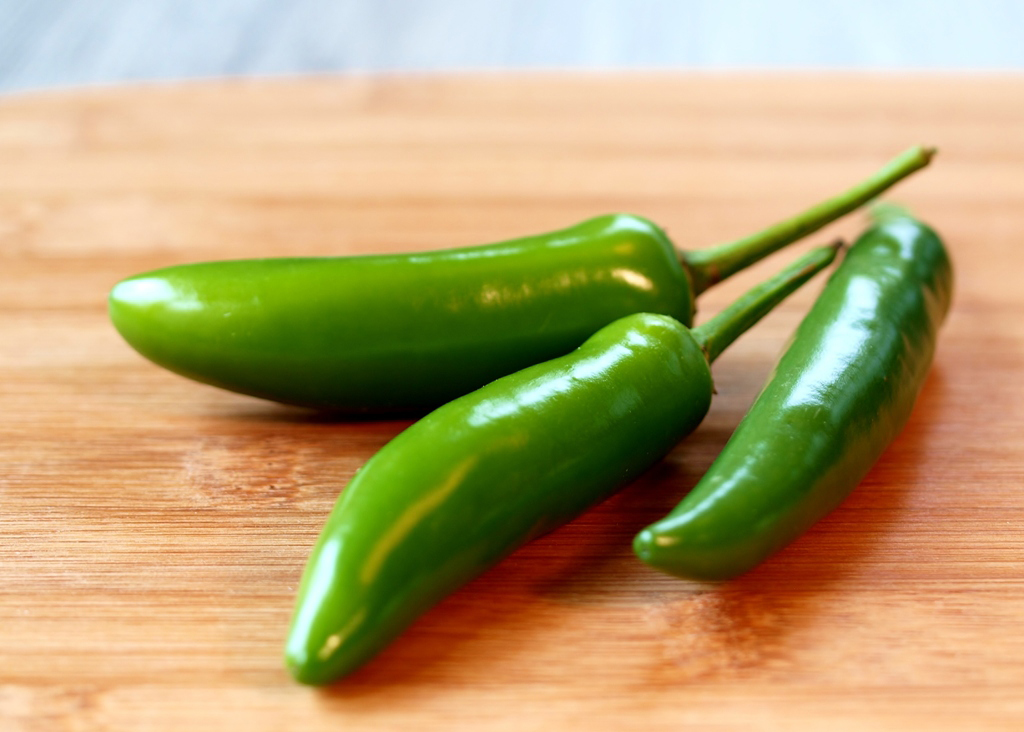
Long, conical shape, cylindrical, taper rounded end, Length: 1 and 2 inches; Diameter: 1/2 inch (Fruit) |
| Calories |
34 Kcal./cup |
| Major nutrients |
Vitamin C (52.33%)
Vitamin B6 (40.77%)
Copper (15.00%)
Iron (11.25%)
Vitamin K (10.33%)
|
| Health benefits |
Treats cancer, Blood vessels, Brain health, Treats anemia, Thyroid functions |
| More facts about Serrano pepper |
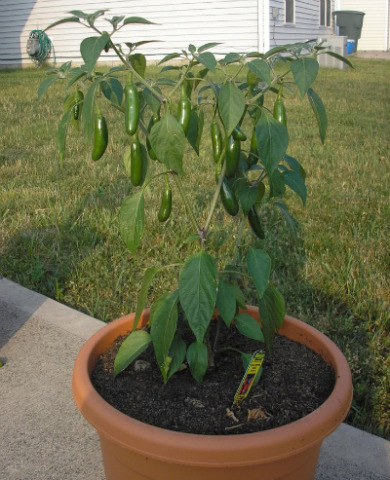
Serrano pepper is a hot chili pepper cultivar which is mostly used as a spice. Taxonomically it is classified under the species Capsicum annuum. Serrano has the habit growing typically 2 and 3 feet tall, with long, conical shape fruits that are cylindrical having taper rounded end; 1 and 2 inches long and 1/2 inch in diameter. Serrano peppers are hot, often 5 times hotter than Jalapeno pepper on the Scoville scale (5000-20000 units). Flavor is described as sweet, mild and rich. The fruit is harvested when they are green or gets ripened. The color of Serrano peppers varies at the maturity which may be brown, yellow, green, orange or red. The common uses of Serrano pepper include salsas, relishes, sauces, pickling and garnishes. Common names of Serrano pepper include Sport Pepper and Chili Seco which belongs to the Solanaceae family.
History
Serrano pepper was originated in the Mexican states of Puebla and Hidalgo. Serrano pepper has an honorable history in the Mexican cooking. It is common chilies in the world which is very flavorful. Hence, many Mexican dishes include this pepper to add flavors. Serrano peppers got its name from the area of Mexico where it is predominantly from Mexican states of Puebla along with Hidalgo which are mountainous. In Spanish, the word sierra means mountain and Serrano is the modification of this word.
Plant
It is a perennial plant which prefers hot and humid climates and thrives in well drained soils. The plant bears a white flower which turns to dark green or red fruit which is long, conical, cylindrical, taper rounded end, 1 and 2 inches long and 1/2 inch as a diameter. The fruit has thick and firm skin.
Nutritional value
One cup (105 grams) of Serrano pepper provides 34 calories, 0.46 grams of lipid fat, 1.83 grams of protein and 4.02 grams of total sugars. It provides 52.33% of Vitamin C, 0.53 mg of Vitamin B6, 0.135 mg of Copper, 0.9 mg of Iron, 12.4 µg of Vitamin K, 3.9 grams of total dietary fiber and 1.614 mg of Vitamin B3.
Health Benefits of Serrano pepper
Besides their spicy taste and flavor, Serrano peppers are delicious and good for the health. It contains low amount of calories, cholesterol, fats, carbohydrates and sodium. It consists of plenty amounts of vitamins but minerals are available in small amounts. The capsaicin provides anti-inflammatory properties; provide relief from migraine and headaches. Other benefits are described on detail below:
- Treats cancer
The high intake of Vitamin C helps to promote the effects of cancer fighting drugs which is used in chemotherapy. Vitamin C only targets the cells which are in need of nutriments without harming the normal cells. The research shows that Vitamin C is an effective remedy for treating lung and ovarian cancer.
- Blood vessels
Vitamin B6 is essential to regulate the homocysteine levels which could be obtained from the consumption of protein sources such as meat. The high homocysteine levels in the blood are associated with the inflammation, blood vessel disease, heart disease which leads to heart attack. The low presence of Vitamin B6 leads to the buildup of homocysteine levels and also damages the linings of blood vessels. This can result to harmful plaque buildup that contributes to stroke or heart attack. The studies show that the intake of Vitamin B6 with folate helps to reduce the homocysteine levels. Vitamin B6 also cures the blood vessels damage. Vitamin B6 manages the levels of cholesterol and blood pressure which prevents the heart disease.
- Brain health
Vitamin B6 assists in the functioning and development of brain. The studies have shown that deficiency of Vitamin B6 impacts on the memory function, dementia, Alzheimer’s and cognitive impairment. The studies show that deficiency of Vitamin B6 contributes to the Alzheimer’s disease.
Vitamin B6 helps to control the homocysteine levels which are the main causes for heart disease. It is essential for the production of hormones such as norepinephrine and serotonin which regulates the energy, mood and concentration. The research shows that ADHD in children is caused due to the low level of serotonin so intake of vitamin B6 might be helpful to the children having behavior and learning disorders.
- Treats anemia
Iron and copper combines together for the synthesis of red blood cells and hemoglobin. The study shows that copper helps to absorb iron from an intestinal tract and releases in the liver where it is stored.
The intake of iron from supplements or food sources helps in the production of red blood cells. An anemia develops in the deficiency of copper and iron. The symptoms of Anemia are muscle aches, fatigue, impaired brain function and digestive problems.
- Thyroid functions
Copper is vital for the proper functioning of thyroids. It works together with the minerals such as potassium, zinc and calcium which helps to balance the thyroid activity and prevents hyperthyroidism or hypothyroidism.
As the relationship between the trace minerals is complicated, the rise in one should be balanced by the other. When one of these minerals is present on excess or deficiency then one can suffer from thyroid. The thyroid sufferers could experience from weight loss or gain, fatigue, change in appetite or body temperature and other symptoms.
- Promotes mood
Neurotransmitter functions depend on the adequate amount of iron in the blood for maintaining positive mood. The mood depends on the hormone balance such as dopamine, serotonin and other hormones which cannot be synthesized properly in the low presence of oxygen. Thus the deficiency of iron leads to poor sleep, mood, lack of motivation and low level of energy.
- Density of bones
Vitamin K increases the protein amount in order to maintain the calcium on bones and reduces the chances of osteoporosis. The study have shown that high intake of Vitamin K reduces the chances of bone loss on the people with osteoporosis. Vitamin K is required for the body to use calcium for framing bones. Vitamin K enhances the bone health and reduces the chances of bone fractures in the postmenopausal women who have the high chances of osteoporosis.
In addition to the increase in mineral density of bones, it also reduces the chances of fractures. Vitamin D and Vitamin K works together in order to enhance the density of bones. The evidence shows that Vitamin K has the positive effect on the calcium balance in body. The intake of Vitamin K rich foods by the injured people helps to prevent the sprained ankles and recover the broken bones.
- Assist digestion
Both type of fiber are required for the digestion. Insoluble fiber provides bulk to stool and speeds up the waste to pass fast which helps to prevent bloating, constipation and indigestion. The soluble fiber helps to absorb water in the digestive tract that helps to enhance digestion. One should drink plenty amount of water while consuming the fiber rich foods.
- Cure diabetes
Vitamin B3 helps to treat diabetes as it balances the level of blood sugar. Vitamin B3 helps to enhance the efficiency of treatments of oral drugs which is used for controlling diabetes. Vitamin B3 controls the level of blood glucose effectively in diabetic patients. It also reduces the chances of heart disease and high blood cholesterol which is seen in the diabetic patients.
- Skin disorders
Vitamin B3 is used to treat acne and clears acne when it is applied topically to the skin. The supplements of Vitamin B complex are helpful to deal with the symptoms. Vitamin B3 helps to lower irritation, skin inflammation, flare ups, redness and others. It also treats the skin ailments such as granuloma annulare and bullous pemphigoid which are the painful skin conditions and also causes infection.
How to Eat
- Serrano peppers are ideal for salsas, relishes, sauces, garnishes and others.
- It could be used grilled, raw, ground or chopped for fresh or cooked sauces along with other ingredients.
- This pepper could be pickled with carrots and onions.
- This pepper is used as a flavoring agent for casseroles, stews and egg dishes.
Other Facts
- Serrano mean from the mountains which indicates the Sierra mountain region that located in Mexican states of Puebla and Hidalgo which is where the pepper got originated.
- The states of Veracruz, Nayarit, Sinaloa and Tamaulipas are known as the massive producers of the Mexican Serrano Chiles about 180,000 tons of pods in a year.
- Serrano peppers are five times hotter and spicier if compared to Jalapeno peppers.
- As Serrano peppers are meaty, it does not dry well.
- About 50 pepper pods is hold by each plant.
Precautions
- The seeds contains capsaicin which the mouth searing characteristics.
- Serrano peppers are hot which can irritate the skin and its juice may be painful when it comes in contact with eyes.
- While using peppers, one should wear thin plastic or latex gloves in order to avoid skin irritation.
Comments
comments