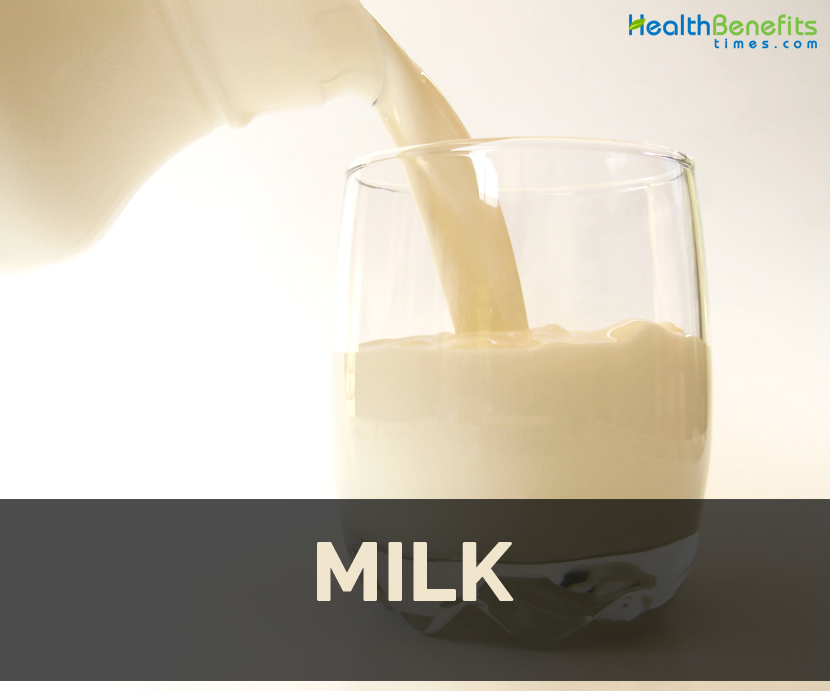
| Milk Quick Facts |
| Name: |
Milk |
| Origin |
In 9000 BC, sheep and goats were domesticated in Afghanistan and Iran. The milk was used to make cheese by the ancient Romans and Greeks. |
| Colors |
White |
| Taste |
Bland and creamier |
| Calories |
152 Kcal./cup |
| Major nutrients |
Vitamin B-12 (47.08%)
Vitamin B2 (32.38%)
Phosphorus (29.71%)
Calcium (28.20%)
Isoleucine (24.34%)
|
| Health benefits |
Provides calcium, Healthy heart, Bone health, Teeth problems, Hydrates body |
| More facts about Milk |
Milk is known as the pale liquid which is considered as the vital source of nutrients. The lactation milk has colostrum which transfers the antibodies of mothers to the young infants that prevents the body from various diseases. Humans and other mammals produce milk in order to feed offspring. The milk of sheep, goats etc is used but the cow’s milk is mostly preferable. It contains various nutrients that helps to prevent the number of health ailments. Milk provides smooth skin, strengthens bones, prevents illness; enhance immune system, treats dental decay, hypertension, respiratory ailments, osteoporosis and obesity. Nowadays various alternatives of milk are found such as coconut milk, almond milk, hemp milk etc. The dairy products could be added to the diet in form of butter, cheese, dairy whitener, flavored milk, paneer, ice cream, curd and milk sweets.
History
With the domestication of animals the milk was used as a beverage. In 9000 BC, sheep and goats were domesticated in Afghanistan and Iran. The milk was used to make cheese by the ancient Romans and Greeks.
In 1600s the cattle was brought by early colonists to USA. The dairy products were produced on the farm and were consumed. In 1790, Boston, Philadelphia and New York it was sufficiently grown and become the large scale dairy operations. Farmers import the cattle to fulfill the increasing demand. In 1795, Holstein-Friesens was imported, in 1822 Ayrshires and in 1830 the first Guernseys was imported.
In the United States, when the dairy industry was developed, the machines to process milk were also developed. Gail Borden formed the method to condense milk by heating in a limited vaccum. This method stored the water in low volume which prevents the milk from germs.
In 1863, Louis Pasteur (France) makes the pasteurizing method to alleviate the noxious bacteria. In 1908, Chicago became the extensive city for the pasteurized milk. Dr. Henry Thatcher produce the glass milk bottles in 1884 after he saw the milk man deliver the milk in an open bucked where the rag doll was fallen accidentally. United States produced milk about 148 billion lb in 1990.
Nutritional value
One cup of 245 grams of milk offers 152 calories. The same amount offers 47.08% of Vitamin B 12, 32.38% of Vitamin B2, 29.71% of phosphorus, 28.20% of Calcium, 24.34% of isoleucine, 24.34% of valine, 23.17% of lipid fat, 22.73% of tryptophan, 20.16% of leucine, 19.71% of lysine, 19.32% of histidine, 19.09% of threonine, 18.62% of Vitamin B5, 17.13% of sodium, 16.55% of selenium, 16.43% of Vitamin A and 15.72% of protein.
Health Benefits of Milk
Milk has become a vital part of diet. This liquid provides various amounts of nutrients. Though it is consumed in lunch, breakfast or dinner it provides adequate amounts of proteins, vitamins and carbohydrates. The nutrients which are offered assist in performing various functions. The milk contains calcium that is essential for the formation of teeth and bones. It is also essential for maintaining muscle health. The milk could be obtained from cows, goats, buffaloes, sheep, camels, yaks and humans. Additionally, cow milk is the favored choice for all. The milk is provided to the children as well as adults to maintain the overall health.
- Provides calcium
Milk is considered as the great source of calcium for the body. It prevents the chronic problems such as bone loss, cancer, migraine headaches, arthritic conditions, obesity and pre-menstrual syndrome. It acts as an aid for losing weight and unwanted fats. Calcium is vital for the formation of bones and measurements of mineral density which depends on calcium. Milk is available at cheap price in the market. (1)
- Healthy heart
The study shows that it helps to lower the chances of strokes and cardiovascular ailments. The high intake of calcium regularly helps to lower the atherosclerosis, stroke and cardiovascular problems. Additionally, milk contains potassium and magnesium which performs a vasodilator activity that helps to lower the blood pressure and raise the flow of blood to the organs along with the reduction of stress on the cardiovascular system and heart. (2) (3)
- Bone health
Milk contains high amount of calcium which is vital for the development and growth of bone structures. Osteoporosis is the bone disorder that could be prevented if milk is consumed regularly. The child who has low amount of calcium has high risk of bone fractures and it could take a long time to heal due to the low presence of calcium in the body. (4)
- Teeth problems
The intake of milk is excellent for the maintenance of dental health. It prevents the enamel from the acidic substances. It should be consumed for the maintenance of health and energy. It also reduce the consumption of soft drinks that lowers the chances of weak gums and teeth decay. (5)
- Hydrates body
The body requires fluid which should be replenished frequently. Water is vital for the body so one should drink about 6-8 glasses of fluid. Milk possesses high quantity of water molecules that helps to rehydrate the body. Our body is made about 80% of water so fluid should be balanced in the body to perform the every activity. Dehydration could lead to various health problems. (6)
- Skin health
People use milk for the maintenance of smooth and fair skin complexion. The milk products and milk are used in the preparations of cosmetics. Milk treats the dry skin so one should apply milk to the face and leave it for fifteen minutes and wash it. It smoothens and nourishes the skin. Milk has lactic acid which helps to eliminate the dead skin cells and rejuvenates the skin. Milk has high content of Vitamin A which enhances the skin health from inside. It has antioxidant properties that eradicates the free radicals that are harmful and responsible or the premature aging, spots and wrinkles. (7)
- Excellent diet
The intake of milk promotes the intake of vitamins and minerals. It fulfills the requirement of calcium. Calcium with other minerals is essential for the efficient functioning of the body. (8)
- Reduce acidity
The intake of milk products lowers the chances of acidity in the body. The cold milk is effective to provide relief from acidity.
- Treats cancer
The milk consumption is effective to treat colon cancer. The study shows that food increases the life of the colon cancer patients. (9)
https://www.youtube.com/watch?v=3TNDccBqNvs
Traditional uses
- Milk helps to soothe the mucous membranes.
- It also soothes the rectum.
- It promotes the milk absorption.
- It could soothe the sunburn symptoms.
- Milk is used to remove the makeup.
- The addition of milk to the bath water provides a beautiful skin.
Precautions
Symptoms which might arise with the consumption of milk such as lactose intolerance, acne, cholesterol, milk allergies, weight gain, bone loss, abdominal pain, nausea, gas and diarrhea.
How to Eat
- It could be added to the bowl of hot cereal such as oatmeal, or breakfast.
- It could be used with raisins, nutmeg and cinnamon.
- It is used to make rice pudding with brown rice.
- Kheer is mostly used as the milk dishes in India. The white rice (758 grams) should be soaked in water for about one hour. Then the rice should be drained and heated in a low heat over a large pan. Cook it by covering for about 50 minutes. Then add four cardamom pods and sugar. It should be stirred and cooked for extra 20 minutes. Then remove and stir it in a rose water. It could be served by topping it with almonds.
- The milk could be blended with banana and other fruits.
- Hot chocolate should be heated in milk, honey and unsweetened dark chocolate. Then it should be frequently stirred.
- The dessert could be made by mixing milk along with dry fruits. Figs, dates, apricots and almonds should be soaked in a hot water for about four hours and drain it. It should be grinded to a paste and blended to the sugar and milk. Cream and honey should be added and blended. It should be refrigerated and blended until it gets frothy. Garnish it with grated chocolate and chopped pista.
- Milk is used to prepare a creamy soup. Boil 300 grams of milk and it should be diluted by adding three cups of warm water. Half cup of rice should be added with salt and should be boiled till it is cooked. About 60 grams of butter should be added and use two beaten eggs to thicken it. It could be served with the brine cheese (crused).
Storage
- Milk has perishable nature. It should be refrigerated after opening. It should be kept in a milk container. It should not be kept on the door of refrigerator because the milk is exposed to heat when opened.
- The temperature of refrigerator should be checked regularly.
- The temperature should be less than 4 C (40 F) or lower than that.
- Due to the high sugar content, the condensed milk lasts longer in comparison to evaporated milk.
- The evaporated milk should be freeze.
Other Facts
- It is regarded as the main source of nutrition for infants, mammals.
- The lactation milk possesses colostrum due to which the antibodies of mothers are carried to its young that lowers the chances of various diseases.
- About 730 million tonnes of milk was produced by dairy farms in 2011 from the 260 million dairy cows.
- The largest producer of milk is considered to be India in the world.
- Brazil, China, India and United States are the highest exporters of milk as well as milk products in the world.
- The highest importers of milk in the world are Russia and China.
References:
http://www.lifehack.org/articles/lifestyle/20-cool-uses-for-milk.html
http://www.stylecraze.com/articles/benefits-of-milk-for-skin-hair-and-health/
https://en.wikipedia.org/wiki/Milk
Comments
comments