
Erucic acid, a monounsaturated omega-9 fatty acid marked as 22:1ω9, is found in the oil-rich seeds of the Brassicaceae family of plants notably rapeseed and mustard. It has formula CH3(CH2)7CH=CH(CH2)11COOH. The name is derived from Latin word eruca which means arucola or garden rocket. It is common in wallflower seed with a content of 20 to 54% in high erucic acid rapeseed oil, and 42% in mustard oil. This acid is also known as cis-13-docosenoic acid and trans isomer is called brassidic acid. Though natural forms of mustard and rapeseed contain high erucic acid levels (over 40% of total fatty acids) and levels in rapeseed for food use are below 0.5%.
Erucic acid has similar uses as mineral oils but with a benefit that it is more bio-degradable. It is highly tolerable to temperature which makes it suitable for oil transmission. It is able to polymerize and dry means it can be – and is – used as a binder for oil paints. Erucic acid is broken down long-chain acyl-coenzyme A (CoA) dehydrogenase, which is formed in the liver. This enzyme breaks long chain fatty acid into shorter-chain fatty acids.
Food Sources
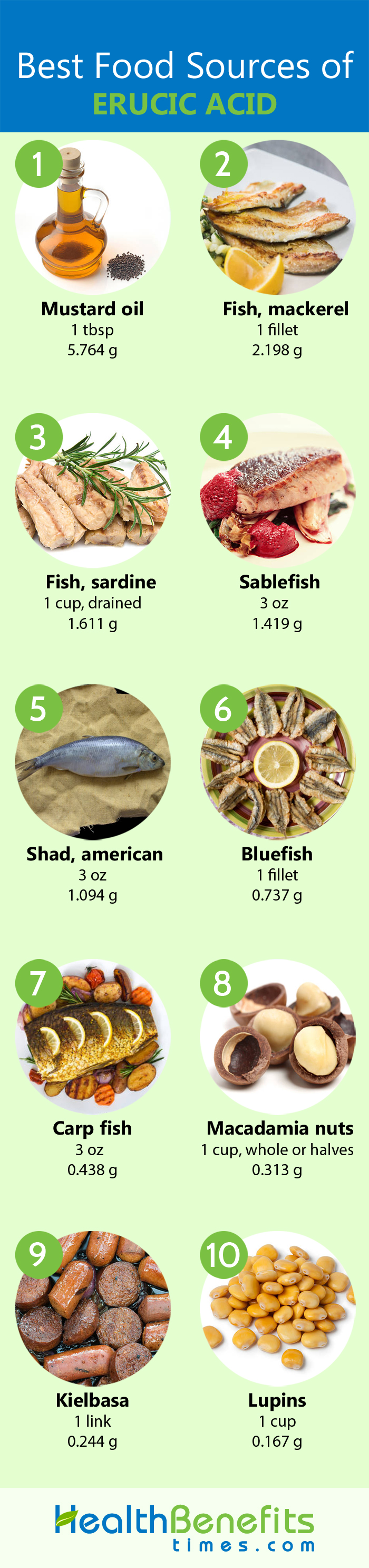
| Food name | Weight (g) | Erucic acid (g) |
| Herring fish | 140 | 7.232 |
| Mustard oil | 14 | 5.764 |
| Halibut fish | 85 | 2.145 |
| Mackerel fish | 112 | 1.576 |
| Bluefish | 117 | 0.737 |
| Sablefish | 28.35 | 0.486 |
| Macadamia | 132 | 0.313 |
| Kielbasa | 370 | 0.244 |
| Lupins | 180 | 0.167 |
| Quinoa | 170 | 0.141 |
| Mustard greens | 150 | 0.106 |
| Swordfish | 85 | 0.109 |
| Sesame seeds | 150 | 0.098 |
| Garden cress | 50 | 0.045 |
| Lotus seeds | 32 | 0.037 |
| Cowpeas | 160 | 0.037 |
| Peanut Butter | 32 | 0.036 |
| Shiitake mushroom | 145 | 0.023 |
| Orange roughy | 85 | 0.021 |
| Buckwheat | 170 | 0.020 |