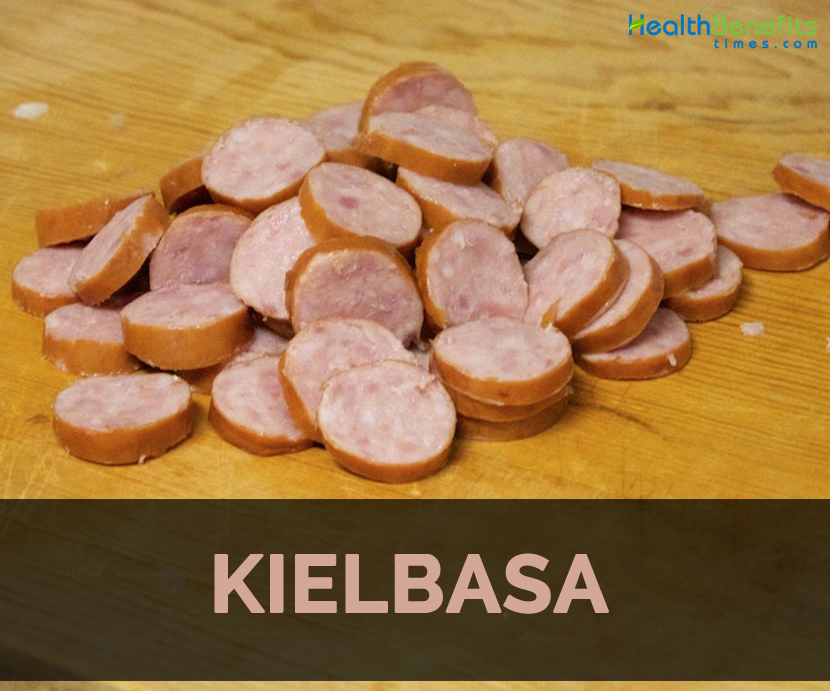
| Kielbasa Quick Facts |
| Name: |
Kielbasa |
| Origin |
Poland |
| Colors |
Dark |
| Calories |
286 Kcal./cup |
| Major nutrients |
Total Fat (72.09%)
Sodium (60.20%)
Selenium (30.55%)
Vitamin B-12 (25.42%)
Isoleucine (25.24%)
|
Polish sausage is found in few varieties, smoked, fresh containing pork but may contain beef. It is flavored with pimento, garlic and cloves. It comes in 2 inch thick diameter and sold after precooked usually or fresh sometimes. Kielbasa, also called polish sausage, is a versatile and tasty smoked sausage. It is used in main dish recipes, soups, casseroles, stews, appetizers and sandwiches. It is used as a delicious breakfast.
Literally, spices are added to the grounded meat with fat. Then mixture is stuffed into hog casings and smoked. It results a flavorful meat sausage which is enjoyed in various ways. Presently, machines are available for making kielbasa or it is available at the grocery store. In Poland, there are two types of Kielbasa varieties: normal sausage and dried. Dry kielbasa lasts longer and still retains its flavor. Dry kielbasa is generally eaten cold and regular one is consumed cold, fried or cooked. In traditional Polish dishes, normal kielbasa is used.
History of Kielbasa
Kielbasa is a term which was not mentioned in history books till 18th century. The term describes a thick sausage with dark color which means it was heavily smoked. Sausage is few feet long and the technique which is used today is called rope sausage. Commonly it was seen on the dinner tables of knights and noblemen of higher stature. During long travels, merchants used to carry sausage and knights carry sausage on their belts.
Today, if you ask for polish sausage or kielbasa in Poland, there are more than 100 types of kielbasa available. During first creation of it, royalty was known to hunt and also to enjoy having prey for dinner. When sausage was created, the addition of other meat with pork and spices such as deer, rabbit and wild boar. With the introduction of these new spices and meat, the recipes were created with new flavor in the process.
Types of Kolbasa
- Varyonaya (boiled kolbasa)
This sausage is made from salted ground meat. It is boiled at 80 degree Celsius temperature. It is usually round and thick.
- Varyono-kopchyanaya (boiled-and-smoked kolbasa)
Firstly, it is boiled and then smoked. It possesses small meat pieces of various sizes by adding cream, milk, starch and flour. It could be preserved for only 10 to 15 days.
- Syrokopchyonaya (Salami)
This sausage is smaller in size than previous one. It is generally smoked at the temperature of 20 to 25 degrees celcius.
- Domashnaya (house kolbasa)
This is the new version of traditional kolbasa. Still it is made with real intestines.
How to make Fresh Kielbasa?
Makes 2 pounds
Active time: 1 hour, including 30 minutes to chill meat
Start to finish: 2 hours
VARIATIONS:
- Substitute 1/2 to 3/4 pound beef chuck for 1/2 to 3/4 pound pork butt.
- Substitute 2 pounds boned chicken or turkey thigh meat, with skin attached, for pork and pork fat. Cook sausages to an internal temperature of 165°F.
Most Americans think of kielbasa as a cooked and smoked sausage; one could find a recipe for that. It’s difficult to find mildly seasoned fresh kielbasa, which is more similar to a subtle Italian sausage, like this one.
Ingredients:
Method:
- If using sausage casings, prepare them as directed.
- Cut pork and pork fat into 1-inch cubes. Place cubes in a mixing bowl, and toss with paprika, mustard seeds, sugar, salt, pepper, marjoram, and thyme. Transfer cubes to a sheet of plastic wrap on a plate and freeze for 30 minutes, or until very firm.
- Grind meat and fat through the fine disk of a meat grinder, or in small batches in a food processor fitted with the steel blade using the on-and-off pulse button. If using a food processor, do not process into a paste, but ingredients should be very finely chopped.
- Combine ground meat, garlic, and wine in a mixing bowl, and knead mixture until well blended. Fry 1 tablespoon of mixture in a small skillet over medium-high heat. Taste and adjust seasoning, if necessary.
- Stuff mixture into casings as described, if using, and twist off into 5-inch links; prick air bubbles with a straight pin or skewer. If time permits, arrange links on a wire rack over a baking sheet and air-dry uncovered in the refrigerator for 1 day before cooking. Alternately, if keeping sausage in bulk, refrigerate mixture for at least 30 minutes to blend flavors.
- Cook sausages as directed to an internal temperature of 160°F when pierced with an instant-read thermometer or as directed in a specific recipe.
Note: Sausages can be refrigerated up to 2 days or frozen up to 2 months. Once cooked, they can be refrigerated up to 3 days.
How to cook Kielbasa?
- Smoked Kielbasa
Makes 2 pounds
Active time: 1 hour, including 30 minutes to chill meat
Start to finish: 5 hours
VARIATIONS:
- Substitute 2 pounds boned chicken or turkey thigh meat, with skin attached, for pork and pork fat. Cook sausages to an internal temperature of 165°F.
- Omit liquid smoke, and hot smoke sausages as described.
The slightly garlicky-smoky flavor in these sausages is what most of us think as kielbasa. By slowly baking them in the oven they’re easy to make.
Ingredients:
- Medium hog sausage casings
- 1 pound boneless beef chuck or beef brisket
- ½ pound pork butt or boneless country ribs
- ½ pound pork fat
- 2 tablespoons smoked Spanish paprika
- 2 tablespoons nonfat dry milk powder
- 1 ½ teaspoons yellow mustard seed
- 1 ½ teaspoons kosher salt
- ½ teaspoon freshly ground black pepper
- ½ teaspoon dried thyme
- ¼ teaspoon freshly grated nutmeg
- ¼ teaspoon liquid smoke
- ¼ cup beer
- 3 garlic cloves, minced
Method:
- Prepare sausage casings as directed.
- Cut beef, pork, and pork fat into 1-inch cubes. Place cubes in a mixing bowl, and toss with paprika, milk powder, mustard seed, salt, pepper, thyme, and nutmeg. Transfer cubes to a sheet of plastic wrap on a plate and freeze for 30 minutes, or until very firm. While meats chill, stir liquid smoke into beer. Set aside.
- Grind meat and fat through the fine disk of a meat grinder, or in small batches in a food processor fitted with the steel blade using the on-and-off pulse button. If using a food processor, do not process into a paste, but ingredients should be very finely chopped.
- Combine ground meat, beer mixture, and garlic in a mixing bowl, and knead mixture until well blended. Fry 1 tablespoon of mixture in a small skillet over medium-high heat. Taste and adjust seasoning, if necessary.
- Stuff mixture into casings as described and twists off into 5-inch links; prick air bubbles with a straight pin or skewer. If time permits, arrange links on a wire rack over a baking sheet and air-dry uncovered in the refrigerator for 1 day before cooking.
- Preheat the oven to 200°F, line a baking sheet with aluminum foil, and arrange sausages on a cooling rack on top of the baking sheet. Bake sausages for 4 to 5 hours, or to an internal temperature of 160°F when pierced with an instant-read thermometer. Remove sausages from the pan with tongs, and serve immediately or cool to room temperature, lightly covered with plastic wrap, and refrigerate.
Note: Sausages can be refrigerated up to 2 days or frozen up to 2 months. Once cooked, they can be refrigerated up to 3 days.
- Warm German Potato Salad with Kielbasa
Makes 4 to 6 servings
Active time: 20 minutes
Start to finish: 45 minutes
VARIATIONS:
German potato salad with mustard seed and vegetables has always been one of my favorite side dishes, and one I frequently serve with sausage. It’s even better with the sausage in the dish.
Ingredients:
- 2 pounds large red-skinned potatoes, scrubbed
- 2 tablespoons vegetable oil
- ½ pound Smoked Kielbasa, Smoky Mettwurst, or purchased cooked sausage, thinly sliced
- 1 medium onion, chopped
- 2 celery ribs, diced
- 2 tablespoons all-purpose flour
- 1/3 cup cider vinegar
- 2 tablespoons chopped fresh parsley
- 1 tablespoon Dijon mustard
- 1 tablespoon sugar
- 1 teaspoon celery seeds
- 1 teaspoon mustard seeds
- ¼ cup chopped dill pickles
- 4 scallions, white parts and 4 inches of green tops, thinly sliced
- Salt and freshly ground black pepper to taste
Method:
- Cut potatoes into 3/4-inch dice, and steam over boiling water for 12 to 15 minutes, or until tender when pierced with the tip of a paring knife. Transfer potatoes to a mixing bowl, and set aside.
- While potatoes steam, heat oil in a large skillet over medium-high heat. Add sausage and cook for 3 to 4 minutes, or until browned. Remove sausage from the skillet with a slotted spoon, and set aside.
- Add onion and celery to the skillet and cook, stirring frequently, for 3 minutes, or until onion is translucent. Reduce the heat to low, stir in flour, and cook for 2 minutes, stirring constantly. Add 1/2 cup water and vinegar, and bring to a boil over medium heat, whisking constantly. Stir parsley, mustard, sugar, celery seeds, and mustard seeds into the skillet.
- Pour dressing over potatoes, and then add sausage, pickles, and scallions. Season to taste with salt and pepper, and serve warm or at room temperature.
Note: The dish can be prepared up to a day in advance and refrigerated, tightly covered. Allow it to reach room temperature before serving.
- Kielbasa and Sauerkraut Cakes
Makes 4 to 6 servings
Active time: 20 minutes
Start to finish: 30 minutes
VARIATIONS:
- Substitute chopped ham for kielbasa.
- Add 1/2 cup grated cheese, such as cheddar or smoked cheddar.
Sauerkraut cakes are part of the German tradition brought to the Midwestern states in the nineteenth century, although few German cookbooks contain them. Adding sausage takes the cakes from a side dish to a main event.
Ingredients:
- 1 pound Russet potatoes, peeled
- 1 pound sauerkraut, well drained
- 1 tablespoon olive oil
- ½ pound Smoked Kielbasa, Smoky Mettwurst, or purchased smoked sausage, chopped
- 2 large eggs
- ¾ cup whole grain Dijon mustard, divided
- 3 scallions, white parts and 3 inches of green tops, chopped
- 2 tablespoons chopped fresh parsley
- 1 tablespoon crushed caraway seeds
- Salt and freshly ground black pepper to taste
- 1 cup plain breadcrumbs
- 3 cups vegetable oil for frying
- ½ cup mayonnaise
- ½ cup sour cream
Method:
- Dice potatoes into 1-inch cubes, and boil in salted water for 10 to 15 minutes, or until very tender. Drain potatoes, shaking in a colander to get out as much water as possible. Mash potatoes until smooth, and set aside.
- While potatoes boil, soak sauerkraut in cold water, changing the water every 3 minutes. Drain sauerkraut, pressing with the back of a spoon to extract as much liquid as possible, and coarsely chop sauerkraut.
- While sauerkraut soaks, heat oil in a medium skillet over medium-high heat. Add kielbasa and cook, stirring frequently, for 3 minutes, or until sausage browns. Remove sausage from the skillet with a slotted spoon, and set aside.
- Whisk eggs and 1/4 cup mustard in a mixing bowl, and add potatoes, sauerkraut, sausage, scallions, parsley, and caraway seeds. Mix well, and season to taste with salt and pepper.
- Place breadcrumbs in a shallow bowl. Divide mixture into 8 to 12 portions, and form into balls. Flatten balls into 1-inch-thick patties, and pat with breadcrumbs on both sides.
- Heat oil in a deep-sided skillet to a temperature of 375°F. Preheat the oven to 150°F, and line a baking sheet with paper towels.
- While oil heats, mix remaining 1/2 cup mustard with mayonnaise and sour cream, and whisk well. Set aside.
- Add patties, being careful not to crowd the pan. Cook patties for 2 to 3 minutes per side, or until browned. Remove patties from the pan with a slotted spatula, and drain well on paper towels. Keep fried sauerkraut patties warm in the oven while frying remaining patties. Serve immediately, passing sauce separately.
Note: The sauerkraut patties can be prepared for frying up to a day in advance and refrigerated, tightly covered. They can also be fried in advance; reheat them in a 375°F oven for 5 to 7 minutes, or until hot and crusty again.
How to Eat
- Kielbasa is served hot or cold, baked, boiled or grilled.
- Kielbasa is garnished with fried onions in Poland.
- Cook it in soups or bake with sauerkraut or added to stews, bean dishes and casseroles.
- It is served as cold cuts on platter.
- It is served with plain vodka or beer.
- Use it as a soup meat.
- It is served as a breakfast or appetizer with dipping sauce.
- It is consumed with scrambled eggs and vegetables.
Other Facts
Kielbasa composes of pork, salt, pepper, garlic and marjoram for centuries. In 1964, government of Poland decides to introduce new variety that contains 20% beef and 80% pork.
References:
https://en.wikipedia.org/wiki/Kielbasa
http://www.geniuskitchen.com/about/kielbasa-414
https://www.thespruceeats.com/top-kielbasa-and-smoked-sausage-recipes-4119785
https://natashaskitchen.com/roasted-potatoes-and-kielbasa/
http://www.chadsbbq.com/what-is-kielbasa/
http://www.tastingpoland.com/food/kielbasa_polish_sausage.html
https://russiapedia.rt.com/of-russian-origin/kolbasa/
Comments
comments